 ZenWrit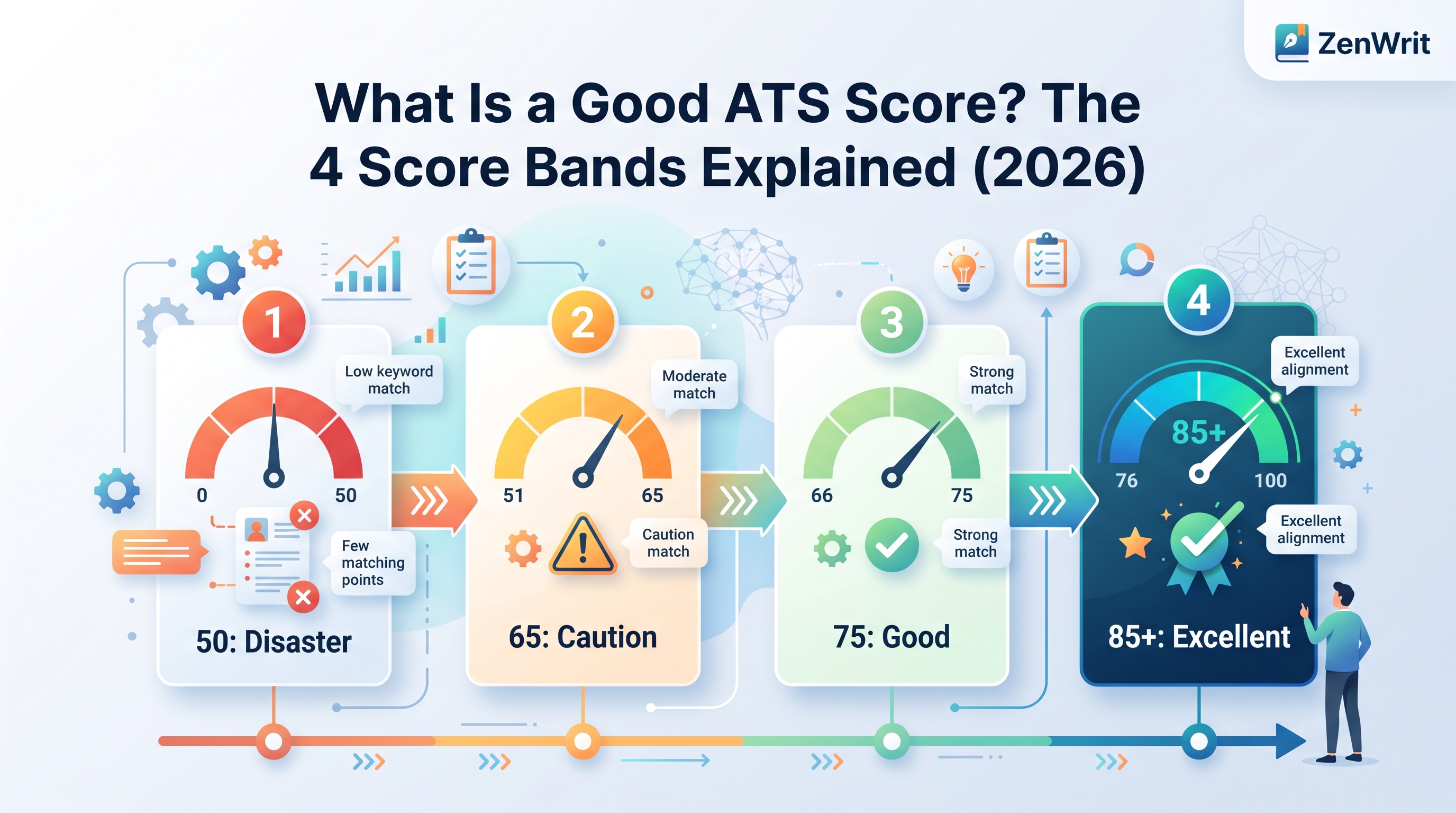
What Is a Good ATS Score? The 4 Score Bands Explained (2026)
You ran your resume through an ATS checker and got a number. Now you're staring at it wondering whether 68 is fine or a disaster. Here's what each score band actually means in 2026.

What Is a Good ATS Score? Bands Explained
You uploaded your resume, got a score back, and now you're staring at a number — 64, 71, 83 — with no real sense of whether to panic or proceed.
Most ATS checkers give you the score and then immediately offer to sell you a subscription to fix it. What they don't give you is an honest answer to the only question that actually matters: what does this number mean for my specific application?
This guide answers that question without a sales pitch attached.
What an ATS Score Actually Measures
Before you interpret the number, understand what it is — and what it isn't.
An ATS score is not a grade on your resume's quality. It is a compatibility estimate: how closely your resume's content, keywords, and formatting align with what a specific job description is asking for (and, separately, how readable your document is to parsing software).
Most tools are measuring two distinct things, sometimes combined into one number:
Formatting compatibility — Can the ATS actually read your document? Does your file parse cleanly, or are sections scrambled by columns, text boxes, or non-standard fonts?
Keyword match rate — How many of the skills, tools, titles, and requirements in the job description also appear in your resume?
A resume can score 90 on formatting and 40 on keyword match. Another can score 45 on formatting and 80 on match. Both would show problems, but for completely different reasons. If your tool gives you one combined number without breaking these down, you're working with incomplete information.
The 4 Score Bands — What Each One Means
Band 1: Below 50 — Filtered Out
At this range, your resume has significant structural problems, major keyword gaps, or both. The formatting issues are usually the more urgent problem. If an ATS can't parse your document because you've used a table-heavy Canva template, placed your contact information in a header that gets skipped, or saved a scanned image as a PDF — your keyword match is irrelevant. The system effectively sees a blank page.
If your score is below 50 and you haven't checked your formatting, do that first. Run a plain-text test: copy your entire resume and paste it into a plain text file. If the result is scrambled, out of order, or missing sections, your formatting is the problem.
What to do: Fix the document structure before changing a single word of content.
Band 2: 50–64 — Needs Significant Work
Your resume is readable, but the gap between what you've written and what this specific job requires is too large for most automated screening thresholds.
This is the most common range for job seekers who have a solid resume they haven't tailored to a specific posting. The resume is fine as a general document — it just doesn't speak the language of this particular role.
The fix here is almost always keyword alignment — our step-by-step guide to aligning your resume with a job description walks through this exact process: finding the specific terms the job description uses for skills you actually have, and making sure your resume uses the same language. Not stuffing — matching. "Project coordination" and "project management" may mean the same thing to you, but an ATS scoring keyword overlap treats them as different terms.
What to do: Go through the job description and find every hard skill, tool, and certification that appears in your experience. Add them to your resume using the exact phrasing from the posting.
Band 3: 65–79 — Competitive, With Gaps
This is where most well-optimized resumes land on the first pass. You'll pass most initial automated filters, but you may not rank at the top of the applicant pool.
Whether 72 is good enough depends entirely on the role. On a niche technical position with 30 applicants, 72 probably moves you forward. On a popular entry-level role at a known company pulling 800+ applications, 72 may not be enough to surface in the recruiter's first-reviewed batch.
The practical question isn't "is this score good?" It's "how competitive is this specific role?" A 75 on a specialized DevOps role is stronger than an 82 on an entry-level marketing coordinator position with three hundred applicants.
What to do: Identify the two or three specific keyword categories where you're losing points — usually missing tool names, missing certifications, or a job title mismatch — and address those. Don't try to fix everything; fix the gaps with the highest individual weight.
Band 4: 80 and Above — Strong Position
At 80+, you've aligned your resume closely enough with the posting that you'll rank well in most automated screening systems. The remaining gap between 80 and 95 is usually minor keyword variations and semantic differences — the kind of thing that doesn't meaningfully separate candidates in practice.
Chasing a higher score above 85 with aggressive keyword insertion often makes the document worse for human reviewers, not better. At this range, the bottleneck shifts from the ATS to the recruiter: does the actual content of your experience make a strong case for this role?
What to do: Stop optimizing the score and start reviewing the substance. Are your bullet points specific and metric-driven? Does your professional summary directly address what this role needs? That's what converts a strong ATS score into an interview invitation.
The Part Most Guides Skip
Your ATS score is job-specific. A resume that scores 84 against one job description can score 51 against a different posting for the same job title at a different company.
This happens because job descriptions for identical roles vary significantly by company size, industry, tech stack, and seniority expectations. Two "Senior Marketing Manager" postings can share a title while asking for almost entirely different skill sets and using different vocabulary throughout.
The practical implication: your score is only useful when measured against the specific posting you're applying to. Generic ATS scores — the ones that measure your resume in isolation without a job description — tell you about formatting compatibility, not match rate. Both matter, but they're answering different questions.
What Actually Moves the Score
Based on how modern ATS systems weight different elements, here's what has the highest impact on your score — in order:
1. Keyword presence in work experience — Skills listed only in a skills section carry less weight than the same skills mentioned inside an actual job bullet point. If you know Salesforce, "managed lead pipeline in Salesforce" scores higher than just listing Salesforce in a skills section.
2. Job title alignment — If the posting says "Data Analyst" and your most recent title is "Data Associate," that gap registers. Where accurate, use the industry-standard title — not necessarily your internal company title — in your resume headline and summary.
3. Section completeness — Missing or oddly named sections cost points. "Where I've Been" doesn't parse the same as "Work Experience." ATS systems are trained on conventional labels; non-standard headings reduce confidence in the categorization.
4. Keyword density without stuffing — Repeating an important term two or three times across different sections (summary, skills, experience) tends to score better than listing it once. Repeating it eight times scores worse — modern systems flag this.
5. Formatting cleanliness — A single-column layout, standard fonts, no tables, no text boxes, no graphics, and a text-based PDF or clean DOCX. This is the foundation everything else sits on.
Check Your Score Before You Submit
The fastest way to know where your resume stands against a specific job description is to test it before you apply.
Run your resume through ZenWrit's free ATS checker before your next application.
Upload your PDF or DOCX, paste the job description, and get a 0–100 score with 20+ specific checks across formatting, keywords, content quality, and recruiter red flags — in under 30 seconds. No account, no credit card, no limit.
→ Check my ATS score free
Frequently Asked Questions
Q: Is 75 a good ATS score?
It depends on the role. For most positions, 75 passes initial automated screening. For highly competitive roles at well-known companies, aim for 80+. For niche technical roles with few applicants, 75 is often strong. Context matters more than the number in isolation.
Q: Can a high ATS score guarantee an interview?
No. A strong ATS score gets your resume in front of a human reviewer — that's all it does. From that point, the quality of your experience, the specificity of your bullet points, and your fit for the role determine whether you get a call. The ATS is a filter, not a hiring decision.
Q: Why does my score drop when I apply to the same role at a different company?
Because the score is a match rate against a specific job description, not a permanent rating. Different companies write job descriptions differently — different tools listed, different terminology, different priorities. A resume tailored for one posting will score differently against another, even for identical job titles.
Q: Should I keyword-stuff my resume to raise my score?
No. Adding a keyword you don't actually have experience with is both a flag for modern ATS systems (which look for contextual usage, not raw presence) and a problem if you get to the interview stage. Add missing keywords only where they reflect real experience you've described accurately. Raise your score honestly or don't raise it at all.
Q: What is the highest ATS score possible?
Most checkers score out of 100, but 100 isn't the goal. Once you're at 80+, you've cleared the filters that matter — the remaining points usually come from minor wording variations that don't change hiring outcomes. Chasing a perfect score with aggressive keyword insertion tends to make the resume worse for the human who reads it next. Aim for 80+, then stop optimizing and start improving the substance.
Was this article helpful?
Be the first to rate this article
Get weekly resume tips
Practical ATS and job search advice every week. No fluff, unsubscribe anytime.
Keep reading


Is your resume ATS-ready?
Run a free compatibility check — no account, no limits, nothing stored.
Check my resume