 ZenWrit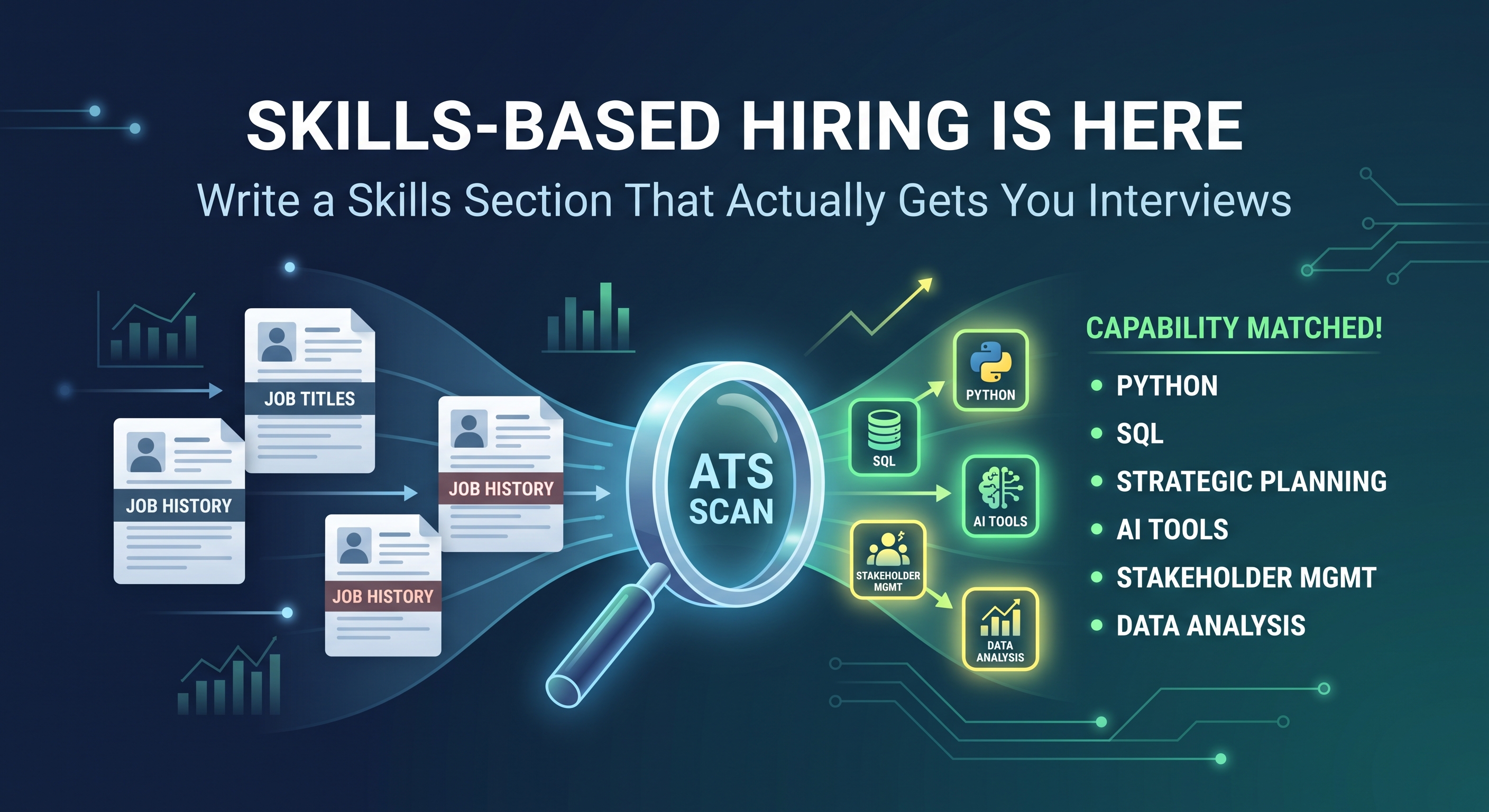
Skills-Based Hiring Is Here: How to Write a Skills Section That Actually Gets You Interviews
Employers stopped scanning for job titles and started scanning for capabilities. Here's what that shift means for your resume, and how to build a skills section that actually survives an ATS.

Skills-Based Hiring 2026: How to Write a Resume Skills Section
Somewhere in the last few years, the resume quietly stopped being a chronology and started being a spec sheet. Recruiters used to scan for job titles and years of experience first. Now, increasingly, they scan for whether you have the specific capabilities a role actually needs — and that shift has changed what a strong resume looks like, whether you've noticed it yet or not.
This isn't a vague "the market is changing" observation. The HBS/Burning Glass Institute research behind HBR's "Skills-Based Hiring Is on the Rise" (2022) analyzed more than 51 million postings from 2017–2020 and tracked what happened after companies started publicly dropping degree requirements. What they found was more interesting than a marketing headline: nearly half of middle-skill roles and close to a third of higher-skill roles saw a genuine, measurable reset in what employers actually required, and most of that shift wasn't a pandemic blip — it started before COVID and looks structural, not temporary. In plain terms: this wasn't a phase. Employers went looking for proof of capability instead of a credential, and they've mostly stuck with it.
Separately, NACE's Job Outlook 2025 found ~two-thirds (64.8%) of surveyed employers use skills-based hiring for entry-level hires — a sharp rise from just a few years ago. Whatever the exact number in your industry, the direction is the same everywhere: less "did you go to the right school," more "can you actually do this."
Why this actually matters for your resume, not just the hiring department
Here's the part job seekers usually miss: this shift didn't just change who gets hired. It changed what gets read first.
Recruiters spend around 7 seconds on an initial resume pass (Ladders' 2018 eye-tracking study). That's not a lot of time to reconstruct your whole career story from a paragraph of narrative. A tight, specific skills section answers their one real question — can this person do the job — faster than anything else on the page. If your skills are buried under a "Summary" paragraph, or worse, missing entirely, you're making a recruiter do work they've already told researchers they don't have time for.
What actually belongs in the section (and what doesn't)
Most skills sections fail in one of two ways. Either they're too vague — "communication," "teamwork," "problem-solving," nothing to back any of it up — or they're bloated, thirty skills deep, half of them barely relevant to the role. Neither one works, and for pretty different reasons.
Pull the skills from the actual posting, not from memory. Read the job description slowly and notice which capabilities get mentioned more than once. Repetition is a signal. If "stakeholder management" shows up in both the summary and the requirements list, that's a phrase an ATS is very likely weighting heavily — and it needs to appear on your resume in that exact wording, not a rough paraphrase you assumed meant the same thing.
Match the wording, not just the idea. This is the single most common thing people get wrong. If the posting says "Python," write "Python" — not "Python programming," not "Py." A lot of ATS systems still do close-to-literal keyword matching under the hood, which means a real, genuine skill can get missed on a technicality of phrasing, not because you don't have it.
Roughly 70% hard skills, 30% soft skills. Hard skills — specific tools, languages, certifications, measurable technical ability — are what usually gets you through the ATS filter in the first place. Soft skills round out the picture for whoever reads it after that, but a section that's mostly soft skills reads as vague rather than qualified, no matter how true they are.
Fewer, sharper skills beat a long list every time. Recruiters have said outright they'd rather see a dozen skills that are obviously relevant than thirty that just pad the section out. A useful gut check: if you wouldn't feel confident fielding a follow-up interview question about a skill, take it off the list. It's not helping you.
Keep the formatting plain, on purpose. No tables, no text boxes, no multi-column layouts, no little icons next to each skill. It looks sharp to a human eye — and it can quietly wreck ATS parsing, your best skills getting skipped or scrambled before anyone actually reads them. Plain labeled section, simple bullets or pipe-separated text. Boring is the point here. (Want to verify your formatting survives parsing? Here's what a good ATS score looks like.)
The 2026 wrinkle: AI fluency is now just expected
One thing that's shifted even in the last year or so — fluency with AI tools has moved from "nice to have" to something close to a baseline expectation across a widening range of roles, and not only in tech. That doesn't mean slapping "ChatGPT" onto your skills list and calling it handled. It means being specific about how you've actually used AI in your work — drafting, analysis, workflow automation, whatever genuinely applies to you — described with the same specificity you'd use for any other tool you know well.
Do you actually need to switch your whole resume format?
Probably not. For most people with a reasonably steady work history, a standard reverse-chronological resume with a strong, dedicated skills section still works, and it's also the format most ATS systems parse the most reliably. A fully skills-first (functional) resume — where skills lead and job history takes a back seat — genuinely helps in narrower situations: career changers moving into a new industry, people with employment gaps, or early-career candidates whose strongest asset is capability rather than a long job history. Outside of those specific cases, a hybrid — solid skills section up top, clear chronological history underneath — tends to satisfy both the ATS and the human reading it, without some of the red flags a purely functional resume can raise.
What to do
Pull up the last job description you applied to and count how many of its required skills actually show up, in matching language, on your current resume. Most people are surprised at how low that number is. Rebuild the skills section around what that specific posting is asking for — matched wording, weighted toward hard skills, formatted plainly — and treat it as something you rewrite for every application, not a fixed block of text you copy everywhere.
How employers actually verify skills now
It's worth knowing what happens after your skills section does its job, because it explains why the section has to be honest, not just keyword-rich. A TestGorilla survey of more than 2,000 hiring decision-makers (2025) found 85% of employers now use some form of skills-based hiring, and 76% use formal skills tests as part of the process. In other words, the skills you list are increasingly the skills you'll be tested on — take-home assignments, work samples, and structured assessments are no longer edge cases.
There's also a shelf-life problem. The World Economic Forum's Future of Jobs Report 2025, based on responses from more than 1,000 employers across 55 economies, found that 39% of workers' existing core skills are expected to be outdated or transformed by 2030. That's an argument for listing skills you actively use and can demonstrate — not ones you touched once three years ago — and for keeping the section current as your toolkit changes.
The upside is real, too. LinkedIn's Economic Graph research found that expanding a search from candidates with matching job titles to candidates with matching skills grew the eligible talent pool by roughly 9.4 times on average. When your skills section is specific and accurate, you're not just passing a filter — you're entering pools of candidates you'd never have appeared in on titles alone.
A worked example: rebuilding a skills section for a real posting
Say the posting is for a marketing analyst role. It mentions "SQL" four times, "A/B testing" three times, and "stakeholder reporting" twice. Your current skills section reads:
Before: Digital Marketing, Analytics, Communication, Team Player, Excel, Problem-Solving, Social Media, SEO, Data Analysis, Leadership, Content Creation, Fast Learner
This is the classic failure mode: a mix of vague soft skills, near-duplicates ("Analytics" and "Data Analysis"), and the one skill the posting cares about most — SQL — missing entirely.
After: SQL (joins, window functions) · A/B Testing & Experiment Design · Stakeholder Reporting · Excel (pivot tables, Power Query) · SEO Analytics · Dashboarding (Looker) · Data Storytelling
Every item maps to something the posting actually asked for, in the posting's own wording. The parenthetical details (joins, window functions) do quiet double duty: they prove the skill is real while giving the ATS more keyword surface to match. Notice what got cut: "Team Player," "Fast Learner," "Leadership" — all possibly true, but none of them is what this posting is screening for. Soft skills belong in your bullet points and interviews, not in the section the ATS reads first.
Frequently Asked Questions
How many skills should I actually list? Somewhere around 10-15 tightly relevant skills beats a sprawling list of 30, almost every time. If a skill wouldn't survive a follow-up question in an interview, it's not helping you on the page either.
Should I switch to a skills-only (functional) resume? For most people, no — a hybrid format with a strong skills section plus a clear chronological work history performs better with both ATS systems and human recruiters. Functional format tends to help most for career changers, candidates with employment gaps, or early-career applicants without much job history yet.
Do ATS systems really penalize slightly different wording? Not exactly "penalize" — but a lot of systems match and rank based on how closely your phrasing mirrors the posting. Writing "ML" instead of "Machine Learning," for instance, can mean a real, genuine skill match simply gets missed — not because you lack the skill, but because of how it was worded.
Do online courses and certifications count as hard skills? They count as evidence — but list the skill, not just the course. "Google Data Analytics Certificate" tells a recruiter less than "SQL · Tableau · R (via Google Data Analytics Certificate)." Employers increasingly respect micro-credentials, but the credential is the proof; the skill is still the headline.
What if I meet most of the listed skills but not all? Apply anyway, and list what you genuinely have. Postings describe the ideal candidate, not the minimum bar — and adjacent experience (you've used a similar tool, done the same analysis in a different context) is often close enough to earn the interview. Just don't list a skill you'd fail a basic follow-up question on; the skills tests described above will find it.
Was this article helpful?
Be the first to rate this article
Get weekly resume tips
Practical ATS and job search advice every week. No fluff, unsubscribe anytime.
Keep reading
Is your resume ATS-ready?
Run a free compatibility check — no account, no limits, nothing stored.
Check my resume