 ZenWrit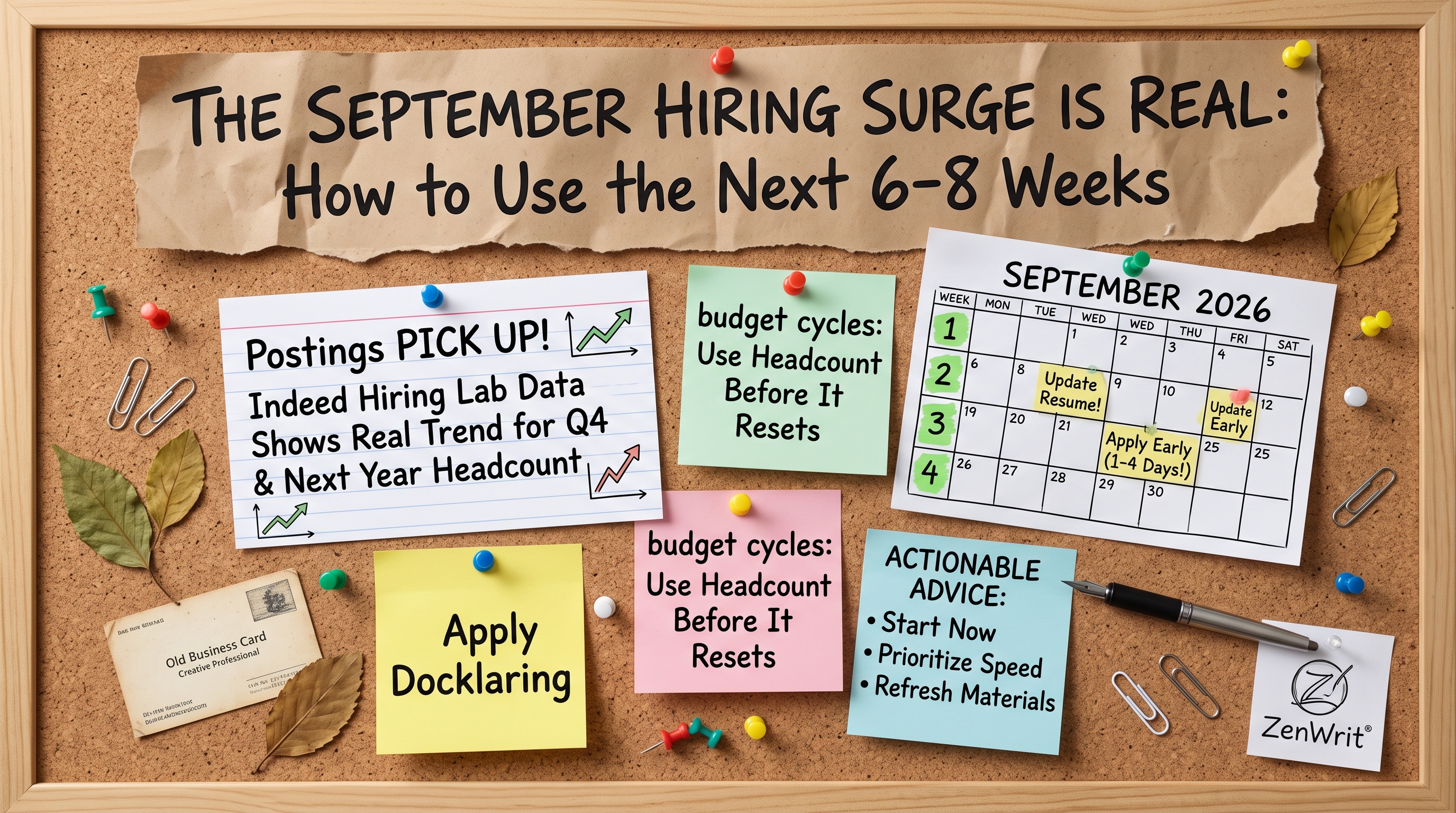
The September Hiring Surge Is Real Here's How to Actually Use It
Job postings consistently pick up every September and October as companies reset budgets for Q4 and next year's headcount. Here's what the data actually shows, and how to use the next 6-8 weeks instead of letting them pass by.

The September Hiring Surge 2026: How to Actually Use It
Right around now, every year, something quietly shifts in the job market. Summer's slow crawl of vacation-delayed hiring decisions ends, and companies suddenly start moving again. It's not a myth job seekers tell themselves to feel better about applying in September — it shows up consistently in the actual posting data, year after year.
Labor-market posting data shows hiring activity picks up in September and October as companies finalize Q4 plans and start budgeting for the following year. It's not the sharpest surge of the calendar year — that title usually goes to the January post-holiday rebound — but it's real, it's consistent, and it lands at a moment when most job seekers have actually eased off after a slow summer. That gap between "the market is picking up" and "most people are still coasting" is exactly where the advantage sits.
Why this happens every single year
It comes down to something almost boring: budget cycles. A large share of companies operate on a calendar fiscal year, which means Q4 is when hiring managers either use up remaining headcount budget before it resets, or start building out plans for January. Summer, meanwhile, is when decision-makers are genuinely harder to reach — vacations stack up, interview panels are incomplete, and offers get delayed simply because someone whose sign-off is needed is out of office. None of that is a conspiracy against job seekers, it's just how corporate calendars work, and it happens to compress into a real seasonal pattern.
There's a second, quieter factor: fewer active applicants. A lot of job seekers who started strong in the spring have simply worn themselves down by August, when replies slow to a crawl during the summer lull. By the time September hiring picks back up, applicant volume per posting is often lower than it was during the busier stretches of spring — meaning your application isn't just landing during a period of more openings, it's landing with less competition per opening too.
What this actually means for the next 6-8 weeks
This isn't a call to panic-apply to everything. It's a case for treating the next month and a half differently than you might have treated August.
Stop waiting for the "perfect" moment to update your materials. If your resume, LinkedIn profile, and portfolio have been sitting untouched since spring, this is the window where that neglect costs the most — postings are picking up right as you'd be starting from a cold start. This realistic AI workflow for job seekers cuts the refresh busywork down without cutting corners.
Prioritize speed on application response. Multiple industry sources point to a similar pattern: applying within the first few days of a posting going live gives you a real edge, since recruiter attention and ATS ranking concentrate on early applicants. A strong application submitted a week late competes against a much larger, and often less relevant, pool.
Don't skip the update just because you're not actively "job hunting." Even if you're not desperate to move right now, September is a strong window to at least refresh your LinkedIn, reconnect with a few dormant contacts, and quietly signal openness — companies are actively planning headcount for January starts right now, and being visible during that planning window matters more than being visible in November when decisions are already locked.
Watch for the layered surge across weeks, not just the month. The bump isn't evenly spread — activity tends to build through September and often peaks into October as Q4 plans solidify. If you can only put in a concentrated push for part of this window, weight it toward the first three to four weeks rather than waiting until late October.
A caveat worth being honest about
Not every sector moves the same way. Healthcare hiring has stayed comparatively strong through 2026's broader labor market softness, while several other sectors have seen postings decline year-over-year even during the usual fall bump. The seasonal pattern is real, but it sits on top of whatever your specific industry is doing overall — a strong seasonal tailwind in a shrinking sector still means real headwinds. Check how your specific field is trending before assuming the general seasonal pattern applies at full strength to you.
What to do
Treat the next few weeks like the start line, not a random stretch of the calendar. Get your resume and skills section actually matched to the roles you want (not just generically updated), turn your applications around within days of postings going live instead of batching them for later, and don't wait until the market "feels" busy to start — by the time it visibly feels busy, the early-mover advantage is already gone. The surge rewards people who were ready before everyone else noticed it started.
What the 2026 data actually shows
The seasonal pattern got an unusual amount of hard data behind it this year. LinkedIn's head of economics for the Americas, Kory Kantenga, told Fortune: "You see more job postings in September than you do any other time during the year, and that happens year after year." Fortune's reporting on LinkedIn's data put numbers on the shape: postings climb to roughly 14% above March levels in September and stay elevated into October, after the usual August dip. Indeed's Job Postings Index shows a similar post–Labor Day ramp-up, concentrated in retail, transportation, and warehousing as employers staff up for Q4 demand.
Here's the part that makes it actionable rather than just interesting: applications don't follow the same curve. Job-seeker applications peak between January and May, then taper through the rest of the year. So September is the rare month where postings climb while the applicant pool shrinks — fewer people competing per opening. One honest caveat, from Indeed Hiring Lab economist Cory Stahle, also via Fortune: "It's not typically a very large bump that we see in the job postings data." The surge is real, but it's a window, not a flood. Treat it like a head start, not a guarantee.
A 6-week September push, week by week
A plan beats good intentions. Here's what a realistic six-week push looks like for someone applying while working full-time:
Week 1 (early September): materials. Refresh the resume and LinkedIn profile before you apply anywhere. Run the resume through the ATS checker, rewrite the skills section against your target role, and update the headline. This is the unglamorous week that makes every later week work better.
Week 2: volume plus targeting. Aim for five to eight tailored applications to fresh postings — ideally less than a week old. Turn each application around within a few days of the posting going live, while recruiter attention is still concentrated on early applicants.
Week 3: the networking layer. Message five to ten people at target companies — not asking for jobs, asking for fifteen-minute chats about the team. September is when hiring managers are planning January headcount, so being visible now plants seeds that sprout in Q1.
Week 4 (early October): follow-ups. Circle back on the week-2 applications with a short, specific note. Most candidates never follow up at all; the ones who do stand out precisely because it's rare.
Weeks 5–6: double down on what's working. By now you'll know which roles are getting responses. Cut the categories that went silent, and spend the remaining energy on referrals and warm introductions into the ones that didn't.
None of this requires quitting your job or spending four hours a day on applications. It's roughly thirty to forty-five focused minutes a day, sequenced so the effort compounds instead of scattering.
Frequently Asked Questions
Is September really better than other months for job hunting? It's one of two strong windows in the year — the other being January/February post-holiday hiring. September-October tends to have a real, consistent uptick in postings, but with typically less applicant competition than the January surge, since fewer job seekers are actively searching right after summer.
Should I hold off applying until October when postings are supposedly at their peak? No — waiting usually backfires. Applicant competition tends to build as the season progresses, and applying early in a posting's life (within the first few days) matters more for your odds than applying during the theoretical "peak" week of the season.
What if my industry isn't hiring right now regardless of the season? The seasonal pattern is a general tailwind, not a guarantee for every sector. If your specific industry has been contracting through 2026, the fall bump may soften that trend without reversing it — worth checking sector-specific data before assuming the general pattern applies fully to your field.
Is December really a dead month for job hunting? Mostly, but not entirely. Hiring activity slows sharply between mid-December and early January as budgets close and decision-makers take time off. That said, the few roles posted in December face very little competition — and some hiring managers like to have an offer out before the January rush. If you're already in a process, keep it alive through December rather than pausing.
Does the September surge apply to remote roles? Only partly. Remote postings follow their own rhythm — they stay elevated year-round because a single remote listing can draw hundreds of applications. The September bump still exists for remote roles, but the competition effect is weaker: more postings, but also more applicants per posting. For remote searches, timing matters less than how sharply your application is tailored. (Our remote resume guide covers what remote hiring managers actually screen for.)
Was this article helpful?
Be the first to rate this article
Get weekly resume tips
Practical ATS and job search advice every week. No fluff, unsubscribe anytime.
Keep reading



Is your resume ATS-ready?
Run a free compatibility check — no account, no limits, nothing stored.
Check my resume