 ZenWrit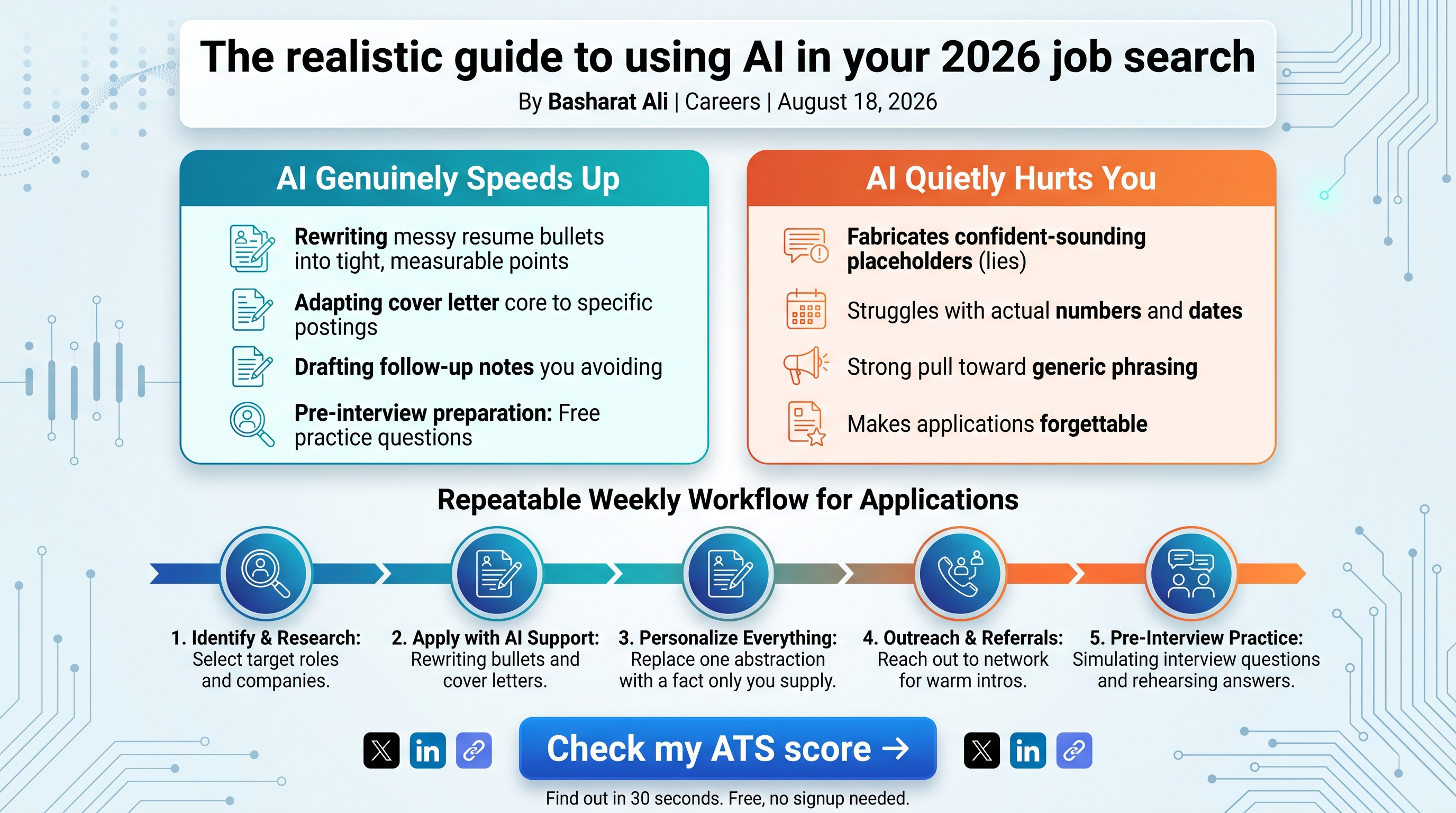
The realistic guide to using AI in your 2026 job search
Where AI genuinely speeds up a job hunt, where it quietly hurts you, and a repeatable weekly workflow for applications.

The realistic guide to using AI in your 2026 job search
Somewhere between "AI will get you hired instantly" and "using AI in your job search will get you blacklisted," there's a much less exciting, much more useful truth: AI genuinely speeds up parts of a job search, quietly wrecks other parts, and the difference usually comes down to which parts you're using it for.
A Gdoc.io survey of 500 U.S. job seekers (August 2026) found 36% now use AI in their search, and that number keeps climbing. At the same time, hiring managers are getting noticeably more skeptical — Robert Half's March 2026 survey of 2,000 U.S. hiring managers found 65% say AI-enhanced resumes make it harder to verify skills, while 67% of HR leaders say AI-generated applications are slowing hiring, not speeding it up. Both things are true at once. Here's how to land on the right side of that split.
Where AI genuinely helps
Decoding job descriptions. Paste a job posting into an AI tool and ask it to pull out the three or four qualifications that matter most. Postings are often bloated with boilerplate — this cuts straight to what the employer is actually screening for, and tells you which of your own bullet points to lead with.
Tightening language, not inventing it. AI is a solid editor. Feed it a bullet point you already wrote and ask it to make it punchier or more specific. It's a weak author — ask it to invent an achievement from scratch and you'll get generic, unverifiable filler that reads like every other AI-written resume in the stack.
Interview prep. Practicing answers out loud against an AI tool that pushes back with follow-up questions is one of the most underused applications. It won't replicate a real interviewer's judgment, but it's a low-stakes way to catch rambling answers before a real one does.
Company and role research. Before an interview, AI can summarize a company's recent news, product direction, or public statements far faster than manually digging through their site and LinkedIn. Verify anything specific before repeating it in the room — but as a research shortcut, it's genuinely useful.
Cutting the boring parts down. Tailoring a resume and cover letter to a specific posting used to take 30–45 minutes if you did it properly. A solid AI workflow — draft, then edit — gets that down to well under 10 minutes without lowering quality, as long as you're the one doing the final pass. (Here's how to rebuild your skills section around what a posting is actually asking for.)
Where it quietly hurts you
Submitting AI output without editing it. This is the single biggest mistake. Recruiters aren't necessarily running your cover letter through an AI detector — most say they can't reliably tell whether AI was involved. What they can spot is a letter that says nothing specific: vague phrases like "results-driven professional" with no number attached, claims that don't match the resume next to it, or an opening that could have been sent to any company in your industry. That's not an AI problem, it's an editing problem — but AI makes it very easy to skip the editing step.
Letting AI invent your achievements. AI cannot verify what you actually did. It doesn't know your real numbers, your real projects, or your real impact — it can only guess plausibly. If you let it write your bullet points from scratch instead of sharpening ones you wrote, you end up with claims you can't back up in an interview, which is worse than a plainer resume that's accurate.
Sending the identical AI draft everywhere. The candidates falling behind in 2026 aren't the ones using AI — they're the ones using it to mass-produce fifty identical applications. ATS systems and human reviewers both catch this pattern: generic phrasing, no reference to the specific role or company, the same three bullet points reordered. Volume without tailoring is worse than fewer, better applications.
Treating AI as the decision-maker. AI can help you prepare a stronger application and walk into an interview more ready. It cannot replace the actual conversation, your real stories, or the specific evidence that you're a fit. Candidates winning offers in 2026 are using AI to sharpen their own material — not to replace the parts only they can provide.
A workflow that actually works
Paste the job description in, ask what matters most. Get the 3–4 real qualifications the posting is screening for.
Pull your closest matching experience and draft it yourself first. Write the bullet in your own words, even roughly.
Use AI to tighten it, not originate it. Ask it to make your draft sharper or more specific — not to write a new one from nothing.
Fact-check every number and claim it touches. If AI rephrased a bullet and the number looks off, or a claim feels bigger than what you actually did, fix it before it goes anywhere near an application.
Read the final version out loud. If it doesn't sound like something you'd actually say, it's not ready yet — that's usually the giveaway line a recruiter notices first.
The tools worth knowing (and what each one is actually for)
You don't need a stack of twenty AI apps. Most job seekers need four capabilities, and plenty of free tools cover them:
- A strong general editor for tightening resume bullets and cover letters. Use it on drafts you wrote — not as a blank-page author.
- A job-description decoder. Paste the posting in and ask for the three or four must-have qualifications. This is the single highest-value AI use in the whole search.
- A mock-interview partner that asks follow-up questions out loud. The value isn't the AI's judgment; it's hearing your own rambling answer played back to you before a real interviewer does.
- A research summarizer for companies before interviews — recent news, product direction, leadership changes. Verify specifics before repeating them in the room.
Notice what's missing from the list: auto-apply bots that blast out applications, and anything that writes your whole resume from a two-line prompt. Those are the tools behind the generic-application flood that hiring managers are now screening against.
A prompt framework that keeps you in control
The difference between useful AI output and generic sludge is usually the prompt. Here's a three-part recipe: context + constraint + your draft.
Bad prompt: "Write me a resume bullet for a customer success manager."
That returns something like "Results-driven customer success professional with a passion for client satisfaction" — the exact sentence a hiring manager has seen forty times this week.
Good prompt: "Here's a job posting [paste]. Here's my rough bullet: 'Helped customers when they had problems with our billing system and fewer people complained.' Rewrite it to mirror the posting's language for a customer success role, keep it under 25 words, keep it truthful to what I described, and don't invent any metrics."
The second version works because the facts are yours, the wording target is the posting, and the constraint ("don't invent metrics") blocks the AI's worst habit. Every AI-assisted bullet should pass this test: could you defend every word of it in an interview? If yes, the tool did its job. If not, you skipped the editing step.
What to do
Use AI to remove the boring, mechanical friction from your job search — decoding postings, tightening drafts, prepping for interviews, researching companies. Keep yourself in charge of anything that involves a specific claim, a real number, or your own voice. The job search bottleneck was never typing speed. It's still fit, evidence, and how you actually show up — AI can get you to more interviews faster, but it can't take them for you.
Frequently Asked Questions
Can recruiters tell if I used AI for my cover letter?
Usually not with certainty — most say they can't reliably detect it. What they can spot is genericness: vague claims, no company-specific detail, or a mismatch with your resume. That's a tailoring problem, not strictly an AI one.
Is it risky to use AI to write my resume?
It's risky to let AI write it unsupervised. Using it to tighten language or reformat around a job description is low-risk. Letting it fabricate achievements or metrics you can't back up in an interview is where the real risk is.
How much time should AI actually save me per application?
If you're using it well — as an editor, not a ghostwriter — tailoring a resume and cover letter can realistically drop from 30–45 minutes to under 10, without losing quality, since most of that saved time was spent on formatting and phrasing rather than the substance.
Should I tell employers I used AI in my applications?
You don't need a disclaimer on your resume, and most employers don't expect one. What matters is that everything in the application is true and sounds like you. If an interviewer asks directly, be honest — "I used it to tighten my drafts" is a completely normal answer in 2026.
Can AI help with salary negotiation research?
Yes, and this is one of its better uses. Ask for the typical range for the role, level, and city, then cross-check against two or three independent sources before you anchor on a number. AI is good at summarizing public salary data quickly; it's bad at knowing any specific company's bands. Use it for the market picture, not the final number — and read our salary transparency negotiation guide before the conversation.
Was this article helpful?
Be the first to rate this article
Get weekly resume tips
Practical ATS and job search advice every week. No fluff, unsubscribe anytime.
Keep reading
Is your resume ATS-ready?
Run a free compatibility check — no account, no limits, nothing stored.
Check my resume