 ZenWrit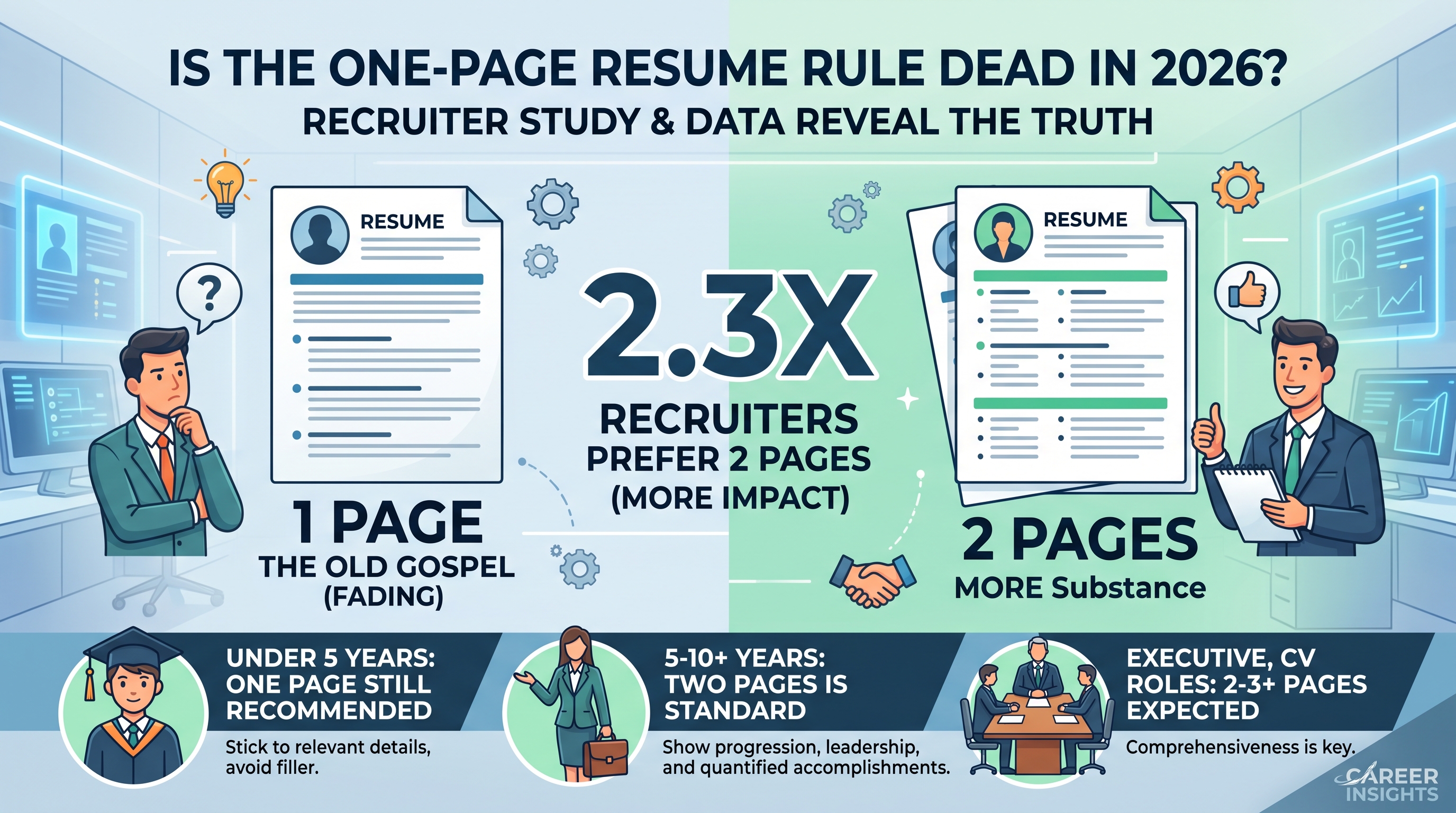
Is the One-Page Resume Rule Actually Dead in 2026?
For decades, one page was gospel. A landmark recruiter study and 2026's own data say otherwise — recruiters now prefer two pages more than twice as often. Here's what the research actually shows, and how to know which one applies to you.

Is the One-Page Resume Rule Dead in 2026? The Research Says Yes
Somewhere in the last few years, a rule that job seekers have treated as near-religious — keep it to one page, no exceptions — quietly stopped matching what recruiters actually say they want. Nobody sent a memo. People are still shrinking margins to 0.4 inches and dropping a strong accomplishment just to avoid a second page, working off advice that increasingly doesn't reflect reality.
The clearest evidence comes from the most-cited baseline in this debate: ResumeGo's 2018 hiring simulation asked 482 recruiters to screen roughly 7,700 resumes, and the results weren't close. Recruiters were 2.3 times more likely to prefer a two-page resume over a one-page one. The surprising part wasn't that experienced candidates benefited from more space — that's intuitive. It's that even for entry-level positions, employers were still 1.4 times more likely to prefer two pages. The "new grads must fit on one page" rule doesn't hold up against the people actually making hiring decisions.
This isn't an isolated finding, either. Monster's 2026 State of the Resumes Report found 49% of job seekers now submit resumes longer than one page. Novorésumé's December 2025 survey of 200+ U.S. recruiters and HR professionals found 68.6% prefer two-page resumes vs 21.6% one-page. And data from resume platform Enhancv shows the actual current split (Enhancv's 2024 user-base data): 47% of resumes submitted today run two pages, 43% stay at one, and the rest go longer.
Why the old rule existed in the first place — and why it's fading
The one-page rule wasn't arbitrary when it was created. It comes from an era when resumes were printed and physically stacked on a hiring manager's desk — a shorter document was genuinely faster to flip through by hand. That constraint doesn't exist anymore. Resumes are digital files, opened on a screen, and most are parsed by an ATS before a human even sees them. No major applicant tracking system rejects a resume for having a second page, and scrolling costs a reader essentially nothing compared to physically turning a printed sheet.
There's a second, more interesting reason two-page resumes are winning in these studies: recruiters actually spend more time with them. In the ResumeGo research, recruiters spent roughly twice as long reading two-page resumes as one-pagers — about four minutes versus two. Two-page resumes also scored 21% higher for "providing a comprehensive summary of the candidate." A recruiter's initial scan is still only six to eight seconds regardless of length, but a resume that survives that first scan and earns a full read benefits from actually having enough substance to read.
So should you just always use two pages?
No — and this is the part most "one-page rule is dead" articles skip past too quickly. The research doesn't say longer is better. It says appropriately longer is better, and there's a real, data-backed range tied to experience level.
Under roughly 5 years of experience: one page, usually. This isn't the old anxiety-driven version of the rule — it's that most people at this stage genuinely don't have enough distinct, relevant material to justify a second page without padding it with weaker filler (unrelated part-time jobs, high school details, restated skills). A second page filled with material that doesn't add real signal actively works against you.
Roughly 5–10+ years: two pages is standard, and often expected. At this point, compressing a decade of progression, leadership, and quantified achievement into one page usually means cutting the exact details that would make you the strongest candidate — the story of your growth, not just your current title.
Executive, academic, medical, and federal roles: two to three pages, sometimes more. These follow entirely different conventions (a CV, essentially) where comprehensiveness — publications, grants, leadership history — is expected, not penalized.
How to build a second page that earns its space
There's a caveat in the ResumeGo findings that most coverage glosses over: in the simulation, the one-page and two-page resumes were deliberately designed to represent candidates with similar levels of experience. Page two won because it carried genuinely useful information, not filler. So if you do expand, treat the second page like it has a job to do.
Front-load page one so it stands alone. The 6-to-8-second scan finding hasn't gone anywhere — a recruiter who doesn't see enough on page one never makes it to page two. Your summary, your most recent role with its strongest quantified results, and your core skills all live on page one. Think of it as the pitch and page two as the evidence room.
Put your highest-value material at the top of page two. The recruiters who committed to reading longer resumes spent that time where it counted. Open page two with your second-most-recent role, your biggest measurable wins, or a "Selected achievements" section — not a chronological trudge into weaker, older material.
Repeat your header on page two. Name, phone, email, and a small "Page 2 of 2" at the top. Pages get separated — a printed page gets misplaced, an attachment opens at the wrong page. A floating second page with no name on it is a small failure of craft that costs nothing to prevent.
Break cleanly. Never let a single bullet or a job entry straddle the page break. If a role's last bullet is dangling alone at the top of page two, either tighten page one so the entry fits or move the whole entry down.
What about a third page?
Don't read the two-page research as "longer is always better." Three pages is where the consensus genuinely thins. In Enhancv's 2024 user-base data, only 10% of resumes ran three pages or longer — it's firmly a minority format. A third page is defensible in a few specific cases: academic and research CVs (publications, grants, teaching), federal resumes (which have their own notoriously exhaustive format), medical roles, and genuinely executive careers where board roles, P&L history, and multi-company leadership need documenting. For everyone else, the honest test is the same one as below: if you cut the weakest third of the document, would anything on page three actually be missed? Usually not.
A simple decision framework
Stop thinking in rules of thumb and run your resume through three questions instead:
- How many years of relevant experience do you have? Under five: one page, almost always. Five to ten: two pages is standard. Ten plus: two pages confidently; three only if the material is genuinely dense.
- Can you fill page two with material that would change a hiring decision? If the second page holds real achievements — revenue numbers, scale, promotions — take the page. If it would hold older, weaker roles or stretched bullets, tighten back to one.
- What does your target industry expect? Tech and startups skew tolerant of two pages for anyone mid-career. Finance and consulting still tend to reward concision. Academia, medicine, and government have their own length norms — follow those, not the general debate.
The real rule underneath all of this
Across every version of this research, one idea repeats: length is a symptom of what you have to say, not a decision you make first. The genuine, useful version of the old one-page instinct is this — most resumes are too long for what they actually contain, not too long in an absolute sense. A one-page resume that's 40% filler is worse than a full two pages where every line is doing real work. The test was never "how many pages." It's "would a recruiter skim past this line without it costing them anything." If a bullet doesn't help someone decide to call you, it doesn't earn a spot regardless of how much white space you have left.
One practical guardrail worth keeping if you do go to two pages: page two should be at least half full. A resume that spills six lines onto an almost-empty second page reads as poor editing, not as a candidate with a rich enough story to need the extra room. Either fill it with real substance or tighten back down to one page.
What to do
Stop picking the page count first. Write everything genuinely relevant to the role you're applying for — your real, quantified accomplishments, not restated duties — and cut everything that isn't. Let the length settle wherever it lands. If you're under five years into your career and it settles at one page, that's very likely correct. If you're a decade in and it settles at two, that's not a compromise, it's what the data says recruiters actually prefer.
Frequently Asked Questions
Will a two-page resume get auto-rejected by ATS software? No. No major applicant tracking system penalizes or rejects resumes for page count. ATS software parses content, not page totals — the length itself has no technical downside.
I have less than 3 years of experience — should I ever use two pages? Generally, no. The data shows employers still prefer one page for most entry-level candidates, since there usually isn't enough distinct, relevant material yet to fill a second page without diluting it with weaker filler.
What if my two-page resume only has a few lines on the second page? Fix that before submitting. A second page that's barely a quarter full signals poor editing rather than a rich career story. Either add genuinely relevant substance to fill at least half the second page, or tighten the content back down to a strong single page.
Was this article helpful?
Be the first to rate this article
Get weekly resume tips
Practical ATS and job search advice every week. No fluff, unsubscribe anytime.
Keep reading

Is your resume ATS-ready?
Run a free compatibility check — no account, no limits, nothing stored.
Check my resume