 ZenWrit
The 7-Second Resume Scan: What Eye-Tracking Research Actually Shows (and How to Pass It)
Eye-tracking studies show recruiters scan resumes in about 7 seconds — but new 2025 research reveals a second, longer read most advice ignores. Here's how to win both.

The 7-Second Resume Scan: What Eye-Tracking Research Actually Shows (and How to Pass It)
You've spent hours on your resume. Adjusting margins. Rewriting the same three bullets eleven times. Choosing between "spearheaded" and "led."
Then a recruiter looks at it for 7.4 seconds and moves on.
That's not an exaggeration to motivate you. It's the average from an eye-tracking study that literally strapped cameras to recruiters' eyes and recorded where their gaze landed. Seven and a half seconds. Barely enough time to read this sentence.
And here's the part nobody tells you: the number hasn't really changed since 2012. But what happens after those seconds — and what new 2025 research reveals about surviving them — changes how you should build your resume today.
I've dug through every major study on how recruiters actually read resumes: the landmark TheLadders eye-tracking research, a 2024 survey of 418 hiring professionals, and a brand-new 2025 data study of over 4,000 real resume reviews. Here's what they actually show — and the concrete moves that get you past the glance.
The study everyone quotes (and what it really found)
In 2018, career site TheLadders ran one of the most famous experiments in hiring: they fitted 30 professional recruiters with eye-tracking devices and recorded exactly where their eyes went while reviewing resumes.
The headline number: an average initial scan of 7.4 seconds.
But the more useful finding is where those seconds went. Recruiters spent roughly 80% of their scan time on just six data points:
- Your name
- Your current title and company
- Your current start and end dates
- Your previous title and company
- Your previous start and end dates
- Your education
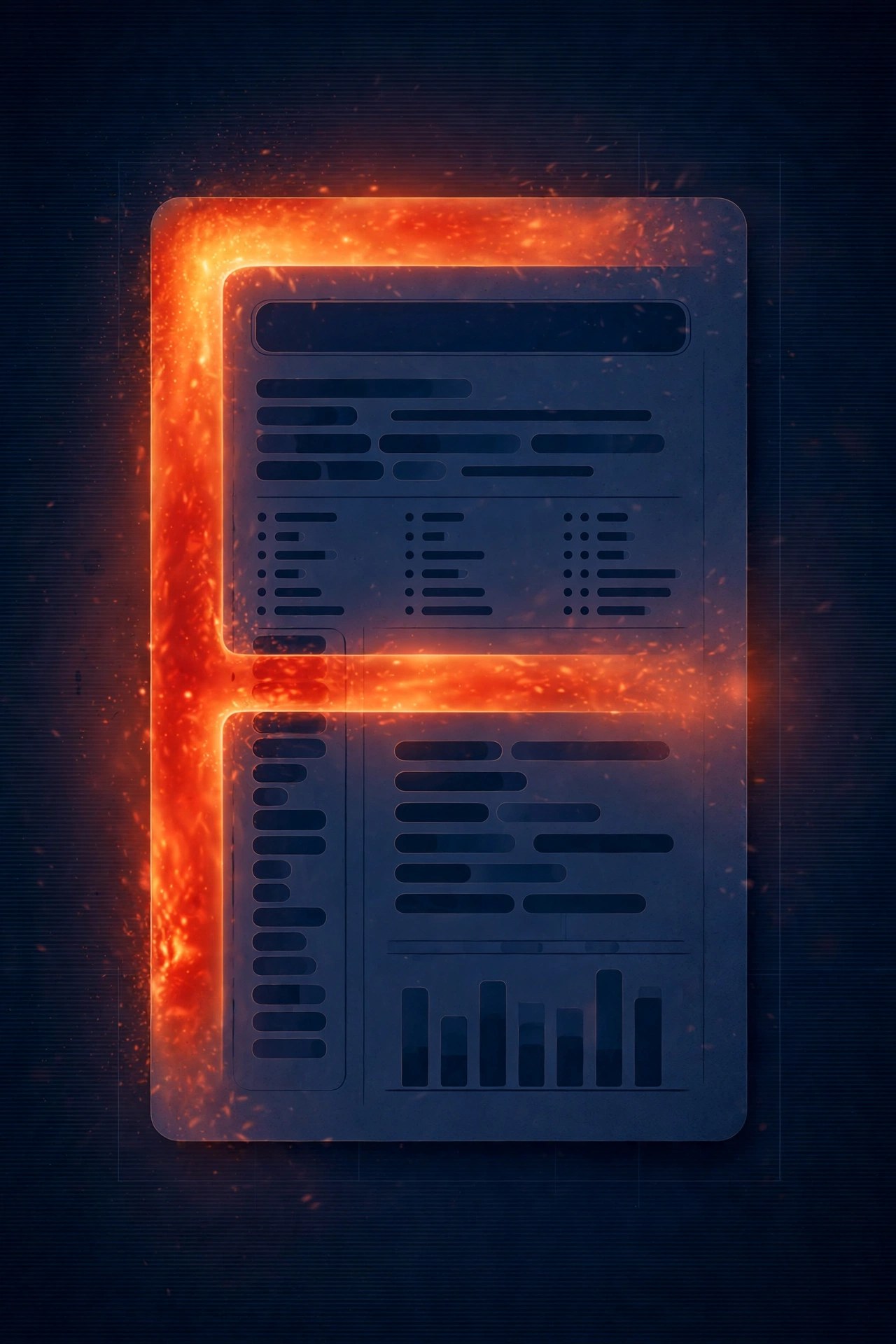
That's it. Five of the six are facts — title, company, dates, school. No amount of clever writing changes them. The study found recruiters scanning in an F-pattern: eyes move across the top of the page, down the left edge, with the top-left corner getting by far the most attention.
Here's the finding that should change how you lay out your resume: resumes with a clear visual hierarchy got 60% more eye time on key information than cluttered ones. And when recruiters compared professionally rewritten resumes against self-written originals, the rewritten versions scored 6.2 vs. 3.9 on a 7-point scale — about a 60% improvement. The takeaway the researchers stated bluntly: trying to make your resume look fancy is the opposite of appealing. Clean structure wins.
One honest caveat before we go further: 30 recruiters is a small sample, and the study never fully disclosed the screening context. So I wouldn't treat "7.4 seconds" as physics. Treat it as what it is — evidence of a triage process, not a reading process. Which is exactly why newer research matters.
What the newer research says (2024–2025)
If the 2018 study was the origin of the "6-second myth," newer studies give you the more useful number — and a much bigger opening.
ResumeGo's 2024 survey of 418 U.S.-based hiring professionals found that 81% spend less than a minute on the initial screening. But here's the twist: only 1% spend less than 10 seconds. The largest group — 47% — spends 30 seconds to a minute on a first look. And 42% say they almost always skim rather than reading line by line.
Translation: the "six seconds" captures only the initial glance — the triage. The honest 2026 reading is that the first look lasts somewhere between a few seconds and a minute, and that window stretches when your resume signals it's worth reading.
InterviewPal's August 2025 data study — 4,289 anonymized resume reviews across 312 recruiters and hiring managers in the U.S., U.K., and Southeast Asia — measured this precisely:
- Average initial scan: 11.2 seconds (notably higher than the old 6–8 second benchmark, partly because AI-assisted review tools show job context side-by-side)
- Median total review time per resume: 1 minute 34 seconds — once a candidate passes the initial fit check
- Gaze time breakdown: 38% on the Experience section, 24% on Summary + Headline, 18% on Skills, 11% on Education, 9% on layout and design
And the triggers that extended reading time are things you can control:
- Clear metric-based achievements: +27% more reading time
- Keywords matching the job description: +19%
- Modern single-column layouts: +14%
That last one deserves a pause. A 2025 experiment by Wonsulting — recruiters wearing hidden eye-tracking equipment, reviewing anonymized resumes — reinforced the same picture: under ten seconds for the initial pass, following predictable visual patterns.
Meanwhile, Monster's State of the Resume 2026 report surveyed job seekers and found a grim mirror image: 77% worry their resume will be filtered out before a human sees it, and only 6% believe recruiters read resumes thoroughly. The belief that "nobody reads it anyway" pushes people toward rapid-fire applications and keyword-stuffed templates — which, ironically, is exactly what makes a resume fail the human scan.
The two-stage reality: triage, then reading
Put the studies together and the actual model of resume review looks like this:
Stage 1 — The triage glance (seconds). The recruiter checks: does this person's title trajectory, companies, dates, and education pattern-match the role? This is the TheLadders 7.4-second window. Most resumes die here — a Workopolis analysis of recruiter behavior found that nearly 60% of employers spend 11 seconds or less viewing a resume before saving or discarding it, and almost 80% of resumes don't get shortlisted.
Stage 2 — The verification read (~90 seconds). If you pass triage, the recruiter actually reads: your bullets, your numbers, your skill match. The InterviewPal study's 1-minute-34-second median total is this stage.
Here's why this matters: most resume advice treats these as one thing. They're not. Stage 1 is about scannability. Stage 2 is about substance. Optimize your resume for the wrong stage and you fail before anyone reads a word.
How to win Stage 1: build for the scan
1. Put the six signals where the eyes go
The eye-tracking data is unambiguous: the top third of page one does the heavy lifting. Make sure this block answers everything instantly:
- Name — large, plain, at the very top-left
- Current title (or a headline that mirrors the role you're applying to) — directly under your name
- Most recent role: title, company, dates — in the first few lines of your experience section
- Education — easy to find, not buried on page two
A two-second exercise: blur everything except the top-left quadrant of your resume. Can a stranger still tell what you do and how senior you are? If not, your Stage 1 is broken.
2. Single column, standard headings, no tricks
This is where "beating the ATS" and "passing the human scan" converge — both systems punish the same designs. Multi-column layouts, tables, text boxes, and skill-rating bars scramble the F-pattern scan and ATS parsing. The InterviewPal data showed single-column layouts earn 14% more reading time. If you want the technical breakdown of what "ATS-friendly" actually means, read my guide on whether ATS software really rejects 75% of resumes.
3. Front-load the left edge
Because of the F-pattern, the left edge of your page gets scanned vertically. This is where your job titles, companies, and dates should live — not your carefully crafted summary paragraph. Objectives, branding taglines, and paragraph-heavy summaries barely register in the first scan. They're not bad. They're just not what wins the glance.
4. Make your skills section a keyword map, not a decoration
18% of recruiter gaze time lands on skills (InterviewPal 2025), and keyword matches earn 19% more reading time. Mirror the job description's vocabulary exactly — not synonyms, the exact phrases. This is the mechanical part of tailoring, and it takes minutes. Once your keywords are in place, check what counts as a good ATS score to make sure the machine side is covered too.
How to win Stage 2: give them something to read
Once you've survived triage, the recruiter spends roughly a minute and a half verifying you. This is where most resumes are surprisingly empty. Three moves buy you that read:
Lead every bullet with a result, not a duty
"Responsible for managing the team" tells the scanner nothing. The InterviewPal data found metric-based achievements extend reading time by 27% — the single biggest lever in the study. Number, verb, outcome: "Cut deployment time from 45 minutes to 4 by automating the release pipeline." If your job genuinely has no numbers, see the skills-based hiring guide for how to frame non-numeric wins so they still read as proof.
Make your last role's first three bullets the whole argument
Remember: 38% of gaze time goes to Experience. Your most recent role's first two or three bullets are the most-read lines on your document. Put your strongest proof there — biggest result, most relevant technology, clearest business impact. Weaker bullets go lower, older roles get fewer lines.
Kill anything that slows a skim
Long paragraphs, nested clauses, acronym soup without expansion — anything that makes a fast reader stall. ResumeGo's survey found hiring professionals skim constantly; 42% say they "almost always" skim rather than reading line by line. Dense text is invisible text.

The AI twist: scans are faster, verification is harder
One more 2026 wrinkle from the Resume Genius Hiring Insights Report 2026 (1,000 U.S. hiring managers): 80% say they can spot an AI-written resume immediately, and 19% use AI specifically to screen out applications before a human reviews them. Combine that with Monster's finding that 77% of job seekers are writing "for software first, hoping people come later," and you get the defining tension of the 2026 job search: everyone's optimizing for the machine and forgetting the human with the 90-second stopwatch.
So here's my honest read of all of this: use AI to tailor keywords and check formatting, but write the bullets like a person who's done the work. The scan is a machine's game. The read is still human.
Your 7-second checklist (do this today)
- Squint test — shrink your resume to thumbnail size. Is the top-left quadrant clean and obviously scannable?
- Six-signal audit — name, current title/company, dates, previous title/company, dates, education. All visible in the top third of page one?
- Kill the two-column layout — single column, standard headings, left-aligned dates.
- Mirror the job post's keywords in your skills section, verbatim.
- Rewrite your three most recent bullets to lead with a number or result.
- Run it through the free ATS checker to catch the parsing errors that kill you before the human scan ever starts.
The 7.4-second number isn't a reason to despair. It's a spec sheet. Build to it, and you stop hoping someone reads your resume — and start making sure they do.
FAQ
How long do recruiters actually spend on a resume in 2026? The most-cited figure is 7.4 seconds from TheLadders' 2018 eye-tracking study of 30 recruiters — but that's the initial triage glance, not the full review. Newer data is more generous: InterviewPal's August 2025 study of 4,289 resume reviews found an average initial scan of 11.2 seconds and a median total review of 1 minute 34 seconds for resumes that pass the first check. ResumeGo's 2024 survey of 418 hiring professionals found 81% spend under a minute on the initial screen, with 47% spending 30 seconds to a minute.
What do recruiters look at first on a resume? Eye-tracking shows recruiters scan in an F-pattern — across the top, down the left edge — spending ~80% of the initial scan on six data points: your name, current title and company, current dates, previous title and company, previous dates, and education.
Is the "6-second resume scan" a myth? Not exactly — it's an outdated simplification. The original 2018 finding (7.4 seconds average initial scan) holds for the triage stage, but it misses the verification read: recruiters who decide a candidate is worth a closer look spend roughly 90 seconds total. The better mental model is a two-stage process: a seconds-long triage, then a ~90-second read.
How can I make my resume pass the 7-second scan? Single-column layout, clear visual hierarchy, the six key signals in the top third of page one, job titles and dates on the left edge, and keywords from the job description mirrored in your skills section. Metric-based achievements (+27% reading time) and single-column layouts (+14%) were the biggest reading-time extenders in InterviewPal's 2025 study.
Does resume length matter for the initial scan? Indirectly. ResumeGo's 2024 data found recruiters are willing to spend more time on resumes that earn it — 73% said they'd spend more time on a longer-than-usual CV, and 79% spend longer when there are fewer applicants. And their 2018 experiment found recruiters were 2.3x more likely to select two-page resumes. The real rule: page one must win the scan; page two exists for the verification read.
Do recruiters really spot AI-written resumes? According to Resume Genius's 2026 survey of 1,000 U.S. hiring managers, 80% say they can spot an AI-written resume immediately. Use AI for keyword tailoring and formatting checks, but write achievement bullets in your own voice.
Want to know if your resume survives the machine before it reaches the human? Run it through ZenWrit's free ATS resume checker — it scores how well an ATS will parse your resume, so the 7-second scan is the only battle left to fight.
Was this article helpful?
Be the first to rate this article
Get weekly resume tips
Practical ATS and job search advice every week. No fluff, unsubscribe anytime.
Keep reading
Is your resume ATS-ready?
Run a free compatibility check — no account, no limits, nothing stored.
Check my resume