 ZenWrit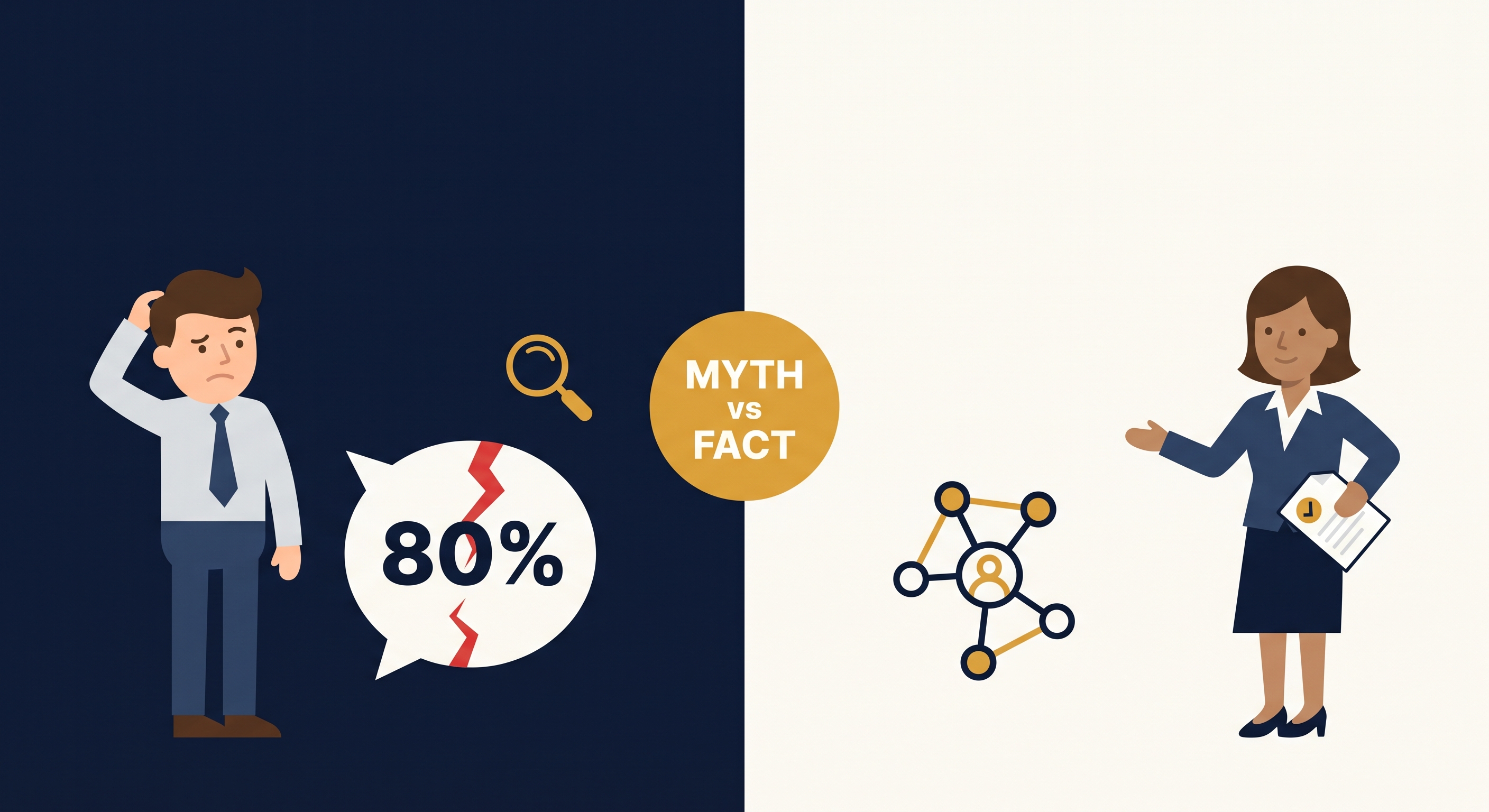
The "80% of Jobs Are Never Posted" Stat Is Fake Here's What's Actually True
You've seen the "70-80% of jobs are never posted" claim everywhere. It has no traceable source. The real, verifiable number is smaller but far more useful here's what actually gets people hired outside job boards.

Search "hidden job market" and you'll hit the same claim on nearly every article: 70% to 85% of jobs are never posted publicly. It shows up in career coaching decks, LinkedIn posts, and dozens of blogs, always stated with total confidence and almost never with a traceable source. Track the citation back far enough on most of these pages and it either dead-ends, points to another blog making the same claim, or cites a study that, on closer look, never actually measured this.
That's worth pausing on, because it's exactly the kind of number that changes behavior. If you believe 80% of jobs are invisible, you might conclude job boards are basically pointless and burn all your time on something else entirely. The real data tells a different, more useful story one with an actual number behind it, and a clear reason why it matters.
What the real number actually is
The verifiable, sourced figure is this: referrals make up roughly 7% of total applicants, but account for 30% to 50% of actual hires at many companies. That's not a rounding error it means a referred candidate is somewhere between 4 and 10 times more likely to get hired than someone applying cold through a job board. Separate data backs the mechanism: LinkedIn's platform data shows referred candidates get interviewed at roughly 3 times the rate of cold applicants, and a majority of employers describe employee referrals as a core part of how they fill roles.
Notice what this number is actually saying, because it's different from the myth. It's not that most jobs are secretly hidden from public view. It's that referred candidates dramatically outperform cold applicants for the same posted roles often because they're evaluated through an entirely different, faster, less crowded process even when the job is sitting on the same job board you applied to.
Why referrals work this well the mechanics, not the mystique
This isn't about who you know in some vague networking sense. There's a concrete operational reason employers lean on referrals so heavily.
Volume is a real problem for employers, and referrals cut through it. A single posted role, especially anything remote or mid-level, can pull in hundreds of applications within days. Most of those get maybe a few seconds of attention from an overloaded recruiter or an ATS keyword filter. A referral skips that queue entirely it usually lands directly with the hiring manager, pre-vouched for by someone whose judgment the company already trusts.
A referral is a form of risk transfer. When an employee refers a candidate, they're putting a small piece of their own credibility behind that recommendation. Companies know this, which is why referred hires are treated as pre-screened in a way a cold resume never is someone already vouched that this person is competent and won't be a disaster to work with.
Speed compounds the advantage. Posting a role, collecting applications, and screening through an ATS can take weeks. A referral conversation can move from introduction to interview in days, because it skips most of the formal intake process entirely.
What this actually means for your job search
The useful version of "hidden job market" advice isn't "stop applying to job boards." It's "stop treating job boards as your only channel, because the data shows a second channel converts dramatically better."
Map who you actually know at target companies before you apply cold. Before submitting through a career site, spend five minutes checking your existing network former colleagues, alumni from your school, people in shared professional groups for any connection at that company. A referral, even a weak one, changes which pile your application lands in.
Informational conversations are a legitimate strategy, not a soft one. Research tracking job seekers who conducted regular informational conversations with people in their target field found they were substantially more likely to receive unsolicited opportunities compared to those who only applied through postings. This isn't about asking a stranger for a job it's about being a known, credible name before a role opens.
Don't abandon job boards combine channels. The strongest approach isn't picking referrals over applications, it's applying to a role through the normal channel and simultaneously trying to find someone inside the company who can flag your application directly to the hiring manager. Both paths running at once beats either one alone.
Ask for referrals specifically, not vague favors. "Do you know anyone hiring?" rarely produces results. "I'm applying for the Product Analyst role at Acme would you be comfortable referring me, or introducing me to someone on that team?" gives a specific, low-effort action someone can actually take.
What to do
Stop chasing the idea that most jobs are invisible, and start acting on the far more useful fact that referred candidates get hired at several times the rate of cold applicants for the exact same roles. Before your next application, spend five minutes checking whether anyone in your network has a connection at that company, and if they do, ask for a specific, actionable referral instead of a general favor. The job board isn't broken it's just the slower, more crowded of two channels, and most job seekers are only using one of them.
Frequently Asked Questions
Is the "hidden job market" completely made up, then? Not entirely internal promotions, executive searches, and some senior roles genuinely get filled without a public posting. But the specific "70-80% of all jobs" figure has no credible, traceable source, and the real, well-documented advantage is how much better referred candidates perform for roles that are posted, not that most jobs are invisible.
How much more likely am I to get hired with a referral? Referrals typically make up around 7% of applicants but 30-50% of actual hires at companies that track this, meaning a referred candidate is roughly 4 to 10 times more likely to be hired than someone applying without one, for comparable roles.
What if I don't know anyone at the company I want to work for? Informational conversations with people in your target field or industry, even without a direct company connection, have been linked to meaningfully higher odds of receiving unsolicited opportunities. Building those relationships before you need them is more effective than trying to manufacture a connection after you've already applied.
Was this article helpful?
Be the first to rate this article
Get weekly resume tips
Practical ATS and job search advice every week. No fluff, unsubscribe anytime.
Keep reading
 Careers
Does LinkedIn's "Open to Work" Badge Actually Help or Hurt You?
5 min read
Read article → Careers
Salary Transparency Laws Changed the Rules — Here's How to Actually Negotiate Now
5 min read
Read article → Careers
Does ATS Software Really Reject 75% of Resumes? Here's Where That Number Actually Came From
6 min read
Read article →
Is your resume ATS-ready?
Run a free compatibility check — no account, no limits, nothing stored.
Check my resume