 ZenWrit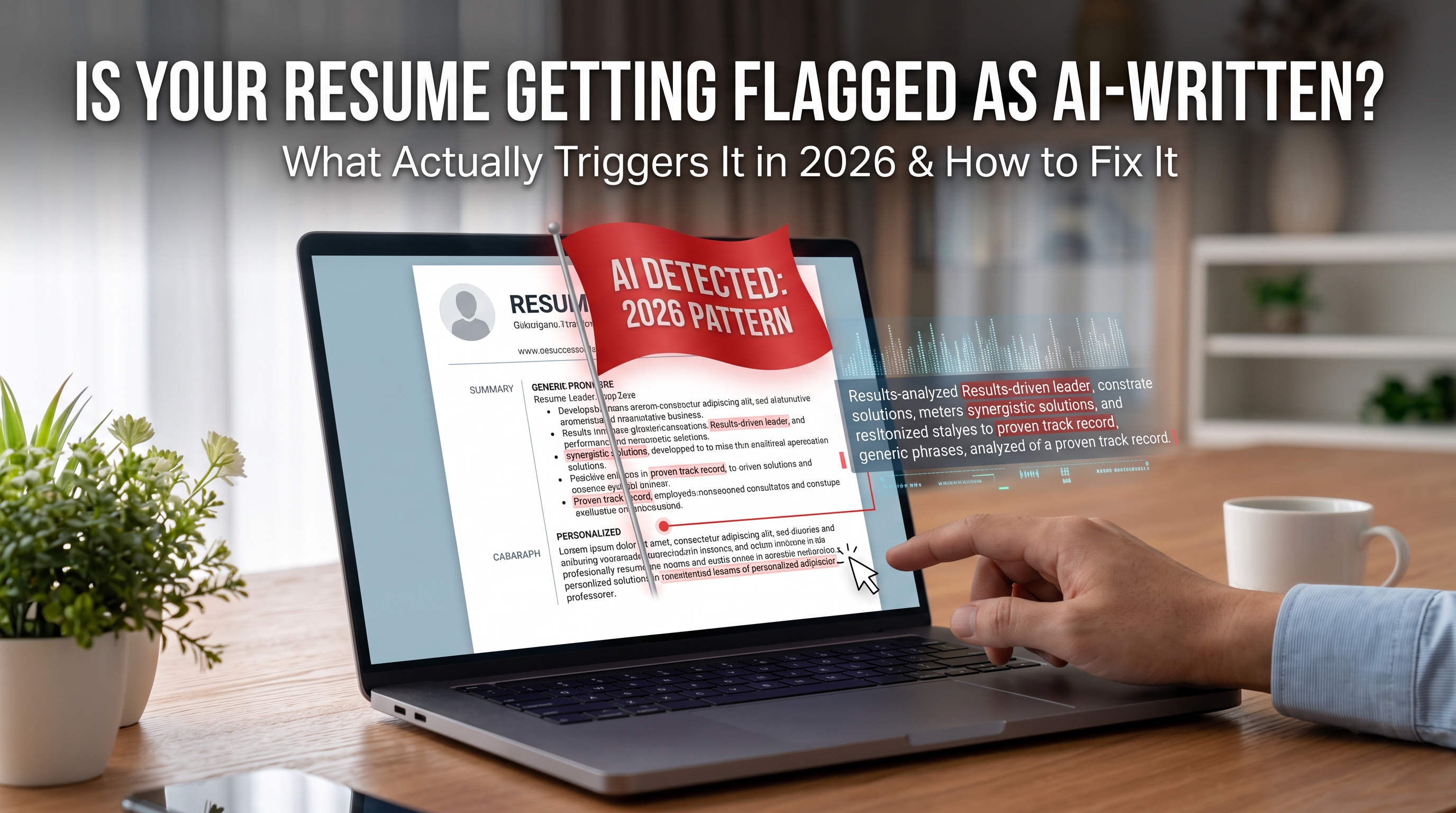
Is Your Resume Getting Flagged as AI-Written? Here's What Actually Triggers It in 2026
More recruiters are screening for AI-written resumes than for typos. Here's exactly what trips the filter in 2026, and the fix that keeps your resume's speed without losing your voice.

Is Your Resume Too AI-Obvious? 2026 Red Flags Explained
AI-obvious writing — not AI use — is what hurts a resume in 2026. Here's what hiring managers actually notice and how to keep your voice.
Open LinkedIn on any given day and you'll find someone warning that AI-written resumes are getting auto-rejected by the thousands. The panic is understandable: if everyone can generate a polished resume in 30 seconds, how do you stand out? And if you used ChatGPT to help write yours, should you be worried?
Let's separate the signal from the noise. The research on this is surprisingly good — and the real story is more interesting than the panic version.
What hiring managers actually say
Start with the numbers, because they're striking. Resume Genius's 2026 Hiring Insights Report surveyed 1,000 U.S. hiring managers, and the results are worth reading slowly:
- Around 8 in 10 (roughly 80%) say they can often tell when a resume was written by AI.
- 77% say many resumes look fully or partly AI-generated.
- 69% say resumes have become more generic and formulaic than they were five years ago.
- 76% say AI-written resumes make it harder to understand what the candidate actually did.
- 72% say overreliance on AI makes candidates seem less skilled.
Read that carefully. The complaint isn't "this person used AI" — it's "this person used AI and the result sounds like everyone else's." The hiring managers aren't running detection software; they're noticing that a flood of applications has started reading like they were written by the same ghostwriter. And they're right: they have been.
This is the part the panic version gets backwards. There's no army of automated detectors scanning your resume for AI text. No major ATS is built to detect AI authorship — JobScan, which builds ATS-matching software, notes that platforms like Greenhouse don't flag AI-written resumes; their AI features rank and match candidates, not scan for AI content. What actually happens is much more human: a person reads your resume, and it sounds like the 40 resumes they just read. Generic, symmetrical, vague. That's the filter — a human reader with a low tolerance for sameness.
Can hiring managers even spot AI writing reliably?
Here's a fun twist: when you test detection ability under controlled conditions, it falls apart.
In a ResumeBuilder survey of 1,000 U.S. hiring managers (2023), only 18% correctly identified all three cover-letter introductions as human- or AI-written. In other words, most hiring managers get this wrong more often than they get it right.
This creates the exact dynamic the data describes: hiring managers are confident they can spot AI writing (four in five say so), but they're largely detecting a style — generic, formulaic, stuffed with familiar corporate phrases — rather than actual AI authorship. A human-written resume that reads like AI-generated slop gets the same penalty. And a carefully written resume that used AI as a drafting tool, then got edited with real specifics, sails through.
The lesson: the question was never "did you use AI?" It's "does this sound like you, or like a template?"
The words that make you sound AI-generated
Some of the most "AI-sounding" words on resumes are actually just tired corporate clichés — and we've got survey data on them going back over a decade.
In a 2014 Harris Poll conducted for CareerBuilder (2,201 hiring managers and HR professionals), respondents named the worst terms to put on a resume. The real list, verbatim:
best of breed, go-getter, synergy, thought leadership, value add, results-driven, team player, strategic thinker, dynamic, self-motivated, detail-oriented, track record.
Those are the 2014 originals. And here's the part I want to be straight with you about: when I show lists of "AI red-flag words" — passionate, seasoned, leveraged, spearheaded, robust, cutting-edge — those aren't from the CareerBuilder survey. Those are my additions. They're the words I keep seeing today's AI models reach for when they fill in a resume, layered on top of the same clichés hiring managers have hated for a decade. The CareerBuilder list is the evidence; the additions are my observation from reading hundreds of AI-assisted resumes.
The fix for both is the same: replace the adjective with the evidence. "Results-driven professional with a proven track record" becomes "Grew regional sales 34% in 18 months." Nobody has ever been hired because of the word "synergy." People get hired because of numbers, specifics, and sentences that could only have been written by someone who was actually there.
When AI help actually works
Here's the part that surprised me: using AI assistance on your resume can genuinely improve your outcomes — when it's the right kind of help.
An NBER working paper by Van Inwegen, Munyikwa & Horton studied 480,948 jobseekers and found that algorithmic writing assistance — suggestions for grammar, word choice, phrasing, and clarity — led to roughly an 8% higher probability of being hired: 7.8% more contracts and 8.4% higher hourly wages, conditional on hire. And critically, this wasn't about AI drafting your resume from scratch. The intervention flagged writing errors and suggested cleaner phrasing. It made people's own content clearer. That's it.
This maps perfectly onto the hiring-manager data. The AI assistance that works makes your writing clearer and more readable. The AI usage that hurts replaces your specifics with generic filler. The line between them is simple: does the AI help you say what you did more clearly, or does it say something vague on your behalf?
How to use AI without sounding like it
Practical rules, from everything above:
- Draft with AI, edit like a human. Use it to get past the blank page. Then rewrite every sentence to include something only you could know: a number, a name, a specific problem, a real decision you made.
- Ban the corporate adjectives. Run a find-and-replace on the CareerBuilder list plus my additions. Every time you delete "results-driven," you have to write what the results were. That's the point.
- Keep your asymmetries. AI writes in balanced, parallel structures — three bullets, all the same length, all starting with verbs. Real careers are lumpy. Let one bullet be long and specific. Let another be short. The unevenness is the fingerprint.
- Read it out loud. If a sentence sounds like it could be on anyone's resume, it will sound AI-written to a tired hiring manager — whether or not AI touched it.
- Use AI for the mechanical parts. Grammar checks, phrasing suggestions, ATS keyword matching — this is the NBER-validated use case. Clarity assistance, not authorship replacement.
What not to do
- Don't paste a fully AI-generated resume and submit it. Not because a detector will catch you — it probably won't — but because it'll read like every other AI-generated resume, and that's the actual penalty.
- Don't assume you're safe because "everyone does it." Everyone doing it is precisely why the generic ones get skimmed past. The bar moved; "good enough" is now the pile.
- Don't overcorrect into anti-AI purism either. Refusing to use a grammar checker on principle is just leaving the NBER-documented 8% on the table. The tool isn't the problem. The sameness is.
The bottom line
Stop asking whether your resume will be "flagged." It won't be — not by software, anyway. Start asking whether it sounds like you or like a template. Four in five hiring managers believe they can spot AI-written resumes, and three-quarters say the AI-written ones make it harder to understand what the candidate actually did. That's not a detection problem. It's a writing problem.
The fix was never to hide your AI use. It's to write something worth reading: specific, uneven, human. AI can help you say it more clearly — the data says it measurably does. Just don't let it say it for you.
Frequently Asked Questions
Can an ATS detect AI-written resumes? No major ATS platform — Workday, Greenhouse, Lever, Ashby — had built-in AI-content detection as of early 2026, per JobScan, which builds ATS AI-matching tools. Their AI features rank and match candidates; they don't scan for AI authorship. The "detection" that matters is a human reader noticing generic, symmetrical, vague writing — and ATS keyword and parsing checks measure skills and match, not whether your prose sounds personal.
Will using ChatGPT to write my resume get me auto-rejected? There's no evidence of automatic rejection for AI use. The documented penalty is subtler: 76% of hiring managers say AI-written resumes make it harder to understand what the candidate did, and 72% say overreliance makes candidates seem less skilled (Resume Genius 2026, n=1,000). Generic writing gets skimmed; specific writing gets read.
What are the biggest AI red flags on a resume? Per hiring managers: generic/formulaic phrasing (69% say resumes have gotten more formulaic), unnatural corporate adjectives, and symmetrical structure with no specifics. The classic offenders — "results-driven," "synergy," "best of breed" — were named the worst resume terms in a 2014 CareerBuilder/Harris Poll of 2,201 hiring professionals, and AI models have only made them more common.
Is it okay to use AI to help write my resume? Yes — with the right division of labor. An NBER study of 480,948 jobseekers found algorithmic writing assistance (grammar, phrasing, clarity suggestions) raised hiring probability by about 8%. Use AI to sharpen your own content; don't let it replace your specifics with generic filler.
How do I make my resume sound human? Replace adjectives with evidence (numbers, names, specific decisions), let your bullet lengths vary naturally, and read the whole thing out loud. If any sentence could appear on a stranger's resume, rewrite it until only you could have written it.
Sources: Resume Genius 2026 Hiring Insights Report (n=1,000 U.S. hiring managers); ResumeBuilder.com 2023 survey of 1,000 hiring managers; CareerBuilder/Harris Poll 2014 (n=2,201 hiring managers and HR professionals); Van Inwegen, Munyikwa & Horton, "Algorithmic Writing Assistance on Jobseekers' Resumes Increases Hires" (NBER Working Paper w30886); JobScan (ATS AI-detection reporting, 2026).
Was this article helpful?
Be the first to rate this article
Get weekly resume tips
Practical ATS and job search advice every week. No fluff, unsubscribe anytime.
Keep reading
Is your resume ATS-ready?
Run a free compatibility check — no account, no limits, nothing stored.
Check my resume