 ZenWrit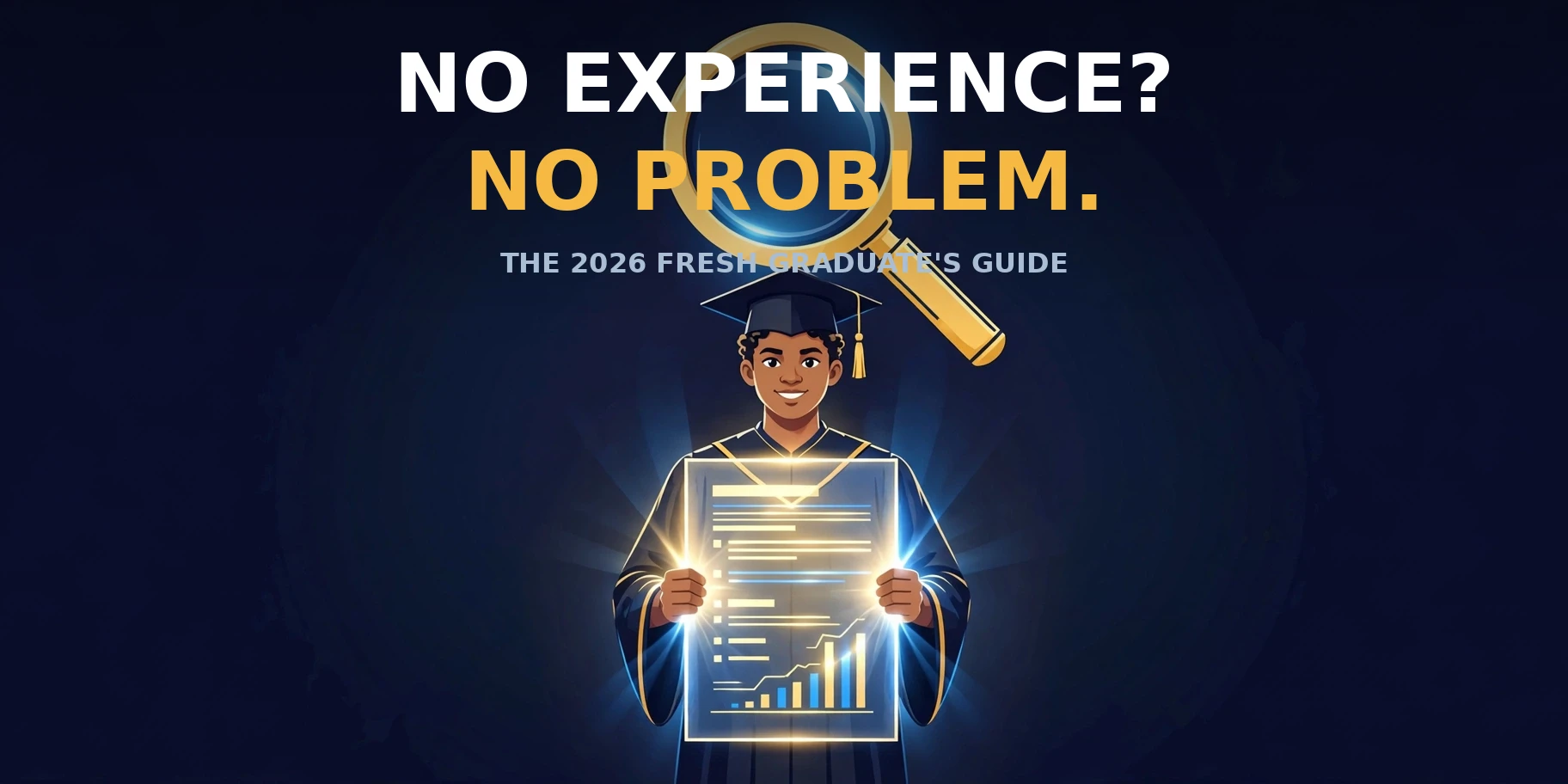
How to Write a Resume With No Experience in 2026: The Fresh Graduate's Guide
No job experience? No problem. A practical 2026 guide for fresh graduates on writing an ATS-friendly resume using projects, skills, and coursework that recruiters actually notice.

Every year, millions of graduates walk into the same wall: you need experience to get a job, and you need a job to get experience. It feels like a riddle designed to keep you out.
Here's the uncomfortable part — in 2026, the wall is measurably taller than it used to be. Indeed's Fresher Hiring Report found that 70% of entry-level jobseekers say entering the workforce is harder now than it was three to five years ago. 72% say entry-level postings demand prior experience. 61% rarely hear back after applying. A foundit talent report from August 2026 put hard numbers on the imbalance: professionals with 0–3 years of experience make up 45% of the engineering candidate pool but only 28% of openings — roughly 9.5 candidates for every job at the entry level, versus 4.1 for senior roles. Entry-level hiring itself is down about 6% year over year, according to LinkedIn's 2026 Grad's Guide.
So no, the catch-22 isn't in your head. If you've ever stared at an "experience required" line on an entry-level posting and laughed a little bitterly — this guide is for you. But — and this is the part most advice skips — the recruiters filling entry-level roles aren't looking for years of employment. They're looking for signals: proof you can do the work, learn fast, and won't need hand-holding from day one. A resume with no traditional "experience" section can send every one of those signals, if it's built deliberately. That's what this guide is about.
The game you're actually playing
Before touching your resume, it helps to know what happens after you click "apply" — because the process is less mysterious than it feels, and the real numbers are more useful than the myths.
First, the software. Jobscan's 2026 research found that 97.4% of Fortune 500 companies use a detectable applicant tracking system. A 2026 Resume Genius survey of 1,000 U.S. hiring managers found 71% personally screen applications through an ATS, 79% have automated at least part of their hiring, and 19% use AI to screen out applications before a human ever reviews them. So yes, a machine reads your resume first at most large companies. That part is real.
What kills resumes at this stage is also documented. In that same hiring-manager survey, the top reasons a resume gets knocked out before a human sees it were missing required skills or poor alignment with the job description (42%) and a lack of relevant keywords (28%). Not fancy formatting tricks. Not a secret blacklist. Just: does this resume contain the words and skills the posting asked for?
One myth worth killing here, because you've definitely heard it: the claim that "75% of resumes are rejected by ATS before a human sees them." We traced that number's origin on this site — it comes from a single 2012 sales pitch, not a study, and most recruiters say their systems rank and sort rather than auto-reject. The real problem was never a robot gatekeeper; it's a crowded field where a weak match gets buried. Read the full breakdown if you want the receipts.
Then comes the human. You've probably heard recruiters spend "7 seconds" on a resume — that number comes from eye-tracking studies run in 2012 and 2018, and it's due for an update. A 2024 ResumeGo survey of 418 hiring professionals found 81% spend under a minute on an initial screen, with the largest group (47%) spending 30 seconds to a minute, and only 1% spending under 10 seconds. The honest reading: your first impression window is tens of seconds, not single digits — and it opens wider for a resume that already matches the posting on the first scan.
For a fresher, the takeaway is blunt but encouraging. You can't afford to lose points on mechanics — missing keywords, broken formatting, a layout that buries your strengths. Those are the cheapest points in the game, and this guide collects all of them. Honestly, most rejected fresher resumes I see don't fail because the candidate wasn't good enough. They fail on things that take an afternoon to fix.
Stop leading with what you don't have
The traditional resume is reverse-chronological: most recent job first, marching backward. That format was designed for people with work history. If you don't have one, don't force your resume into a shape whose entire job is to highlight what you're missing.
Use a hybrid format instead:
- Open with a professional summary — three lines, no apology (more on this below).
- Follow with a skills section — 8 to 12 hard skills relevant to your target roles, grouped by category (Languages, Tools, Methods). This answers the recruiter's real question — "can this person do the job?" — before they can wonder about your employment history.
- Then projects, not employment. Your projects section is your experience section wearing different clothes.
- Education goes next, with relevant coursework spelled out.
Same information, completely different first impression. The recruiter's scanning eye lands on capabilities, not on a blank space where jobs should be.

Your projects are your experience — treat them like it
This is the single biggest mindset shift, and the data says the market is already moving this way. LinkedIn's 2026 Grad's Guide found that 22% of Gen Z jobseekers are building apps, websites, or other projects specifically to showcase their skills, and 21% have started a side hustle or business to kickstart their careers. Employers are increasingly looking for proof of skills over job titles — which means your job is to make your proof impossible to skim past.
That final-year project, the freelance gig for a relative's business, the open-source contribution, the app you built over a weekend — recruiters count all of it. What they don't count is a projects section that just lists names and technologies like a grocery list.
Write each project like a job entry:
- One line of context. "Full-stack task management app, team of 4, built over 8 weeks." Now the reader has a frame.
- Two to three bullets of what you did, starting with action verbs: built, designed, automated, tested, shipped. Not "responsible for" — nobody was responsible for anything; you did things.
- Outcomes with numbers wherever possible. Users, performance improvements, test coverage, grades, stars on GitHub. Numbers are the closest thing a fresher resume has to references.
Compare: "Built a personal portfolio website" versus "Built a responsive portfolio site in React; scored 98 on Lighthouse performance; set up CI/CD deployment." Same project. Completely different signal. The first tells a recruiter you once did a tutorial. The second tells them you think like someone who ships.
One more thing: put a link. A GitHub repo, a live demo, a write-up — anything clickable turns a claim into evidence. If your project isn't online anywhere, that's your weekend task, not a formatting problem. I know it feels like extra work on top of applying, but one link does more for your credibility than a full page of adjectives.
Write a summary that doesn't apologize
Most fresher resumes open with some version of: "Motivated recent graduate seeking an opportunity to leverage my skills and grow professionally." Recruiters have read that sentence ten thousand times. It says nothing, and worse, it sounds like an apology for existing.
A strong fresher summary is three lines:
- Who you are — degree and field.
- Your strongest two or three relevant capabilities, with proof attached.
- What you're targeting.
Here's the difference:
Weak: "Hardworking computer science graduate looking for an entry-level software role where I can apply my knowledge and learn from experienced professionals."
Strong: "Computer Science graduate (2026) with hands-on experience building full-stack web apps in React and Node.js, including a deployed project used by 200+ students. Seeking a junior developer role where I can ship real features from week one."
No apology for being new. Confidence, backed by specifics. If every word of your summary could appear on anyone's resume, delete it and write the version only you could write. Recruiters read hundreds of these — the one that sounds like an actual person is the one they remember.
Keywords decide whether a human ever sees your resume
Here's the part nobody likes: applicant tracking systems don't give freshers a handicap. If the posting asks for "Python, pandas, data visualization" and your resume says "did some coding in college," the software can't connect those dots for you. Remember the hiring-manager data: 42% of early knockouts are missing skills or poor JD alignment, 28% are missing keywords. For someone with no experience section to fall back on, keywords aren't a nice-to-have — they're the whole match.
The process is unglamorous but takes ten minutes per application:
- Open the job description. Highlight every hard skill, tool, and method mentioned — the exact phrasing, not your paraphrase. If it says "data visualization," don't write "data viz."
- Check your resume against that list. The terms you genuinely have (from projects, coursework, self-study) should appear verbatim — in your skills section, your project bullets, or your coursework lines.
- Don't stuff terms you can't back up. One in five hiring managers in the Resume Genius survey uses AI screening, and 80% say they can spot an AI-written resume immediately. Keyword stuffing reads as dishonest to both the software and the human.
The fastest way to check your work: run your resume through our free ATS checker against the specific posting. It flags the exact keywords you're missing in about 30 seconds, so you're fixing a real gap instead of guessing. No account, no limits.

Make your education earn its space
For experienced hires, education is a footnote. For you, it's prime real estate — treat it that way.
Don't just list the degree. Mine it:
- Relevant coursework: 4–6 courses by name, especially ones matching the job's keywords. "Database Systems, Machine Learning, Web Engineering" does more work than a paragraph of adjectives.
- Academic proof: GPA if it's strong (3.5+ or equivalent), dean's list, scholarships, competition placements.
- Thesis or capstone: one line on what you built or researched, with the outcome. A capstone is a project — write it like one.
If your university's name carries weight in your market, keep it prominent. If it doesn't, let the coursework and projects carry the section. Either way, education should read like evidence, not like a form you filled out.
The stuff to leave off
What you cut matters as much as what you keep — especially on one page:
- "References available upon request." Assumed. It wastes a line and dates the resume by about fifteen years.
- High school details. Once you hold a degree, they don't belong. Nobody hiring a graduate cares about your matriculation year.
- A list of generic soft skills — "hardworking, team player, quick learner." These are claims without evidence. Demonstrate them through project bullets instead: "coordinated a team of 4" proves teamwork better than the word "teamwork" ever will.
- Photos, graphics, skill bars, tables, multi-column layouts. These break ATS parsing — most parsers read left to right, top to bottom, and a two-column design gets scrambled into nonsense. A clean single-column layout with standard headings (Summary, Skills, Projects, Education) parses reliably everywhere. We covered why formatting quietly kills resumes in detail — worth the read before you finalize anything.
One page. That's the whole rule for you.
Yes, the one-page rule has nuance for experienced professionals — our research even found recruiters now often prefer two pages for senior candidates. But with no experience, your resume should be one page. Full stop.
If you're stretching past a page as a fresher, you're padding, and recruiters can tell the difference between substance and filler in seconds. One page forces the exact discipline this whole guide is about: signals only, no filler. Everything that didn't make the cut probably wasn't a signal.

Your first-week action plan
Advice is cheap; here's the actual week. If you do only this, you'll be ahead of most applicants in that 9.5-candidates-per-job pile:
Day 1–2: Fix the foundation. Rewrite your resume in the hybrid structure above. One page, single column, standard headings. Run it through an ATS checker once for formatting issues.
Day 3: Build one piece of evidence. Pick your strongest project and make it clickable — push the code to GitHub with a real README, deploy the demo, or write a short post explaining what you built and what broke along the way. A project with a link beats three projects without one.
Day 4–5: Prepare your keyword workflow. Save three target job descriptions. Extract the keyword lists. Build one master resume, then tailor a copy per application — ten focused minutes each, not a rewrite from scratch.
Day 6–7: Apply to 10 roles, early. Timing matters more than people think: recruiters report that applying within the first 48–72 hours of a posting meaningfully improves your odds, because early qualified batches often get reviewed before the flood. Ten tailored applications beat fifty spray-and-pray submissions — and the data backs that up, with 61% of freshers saying they rarely hear back from the spray approach.
Then repeat weekly. The job search is a system, not a lottery ticket. And on the days it feels like shouting into the void — which will happen — remember the numbers at the top of this guide: it's a crowded market, not a closed one. The candidates who break through aren't the luckiest. They're the most deliberate.
Frequently Asked Questions
Can I really get hired with zero work experience? Yes — every employed person alive was hired for a first job once. Entry-level roles exist precisely for this; what gets you hired is proof of capability (projects, skills, coursework), not an employment history you couldn't possibly have yet. The 2026 data shows the market is competitive, not closed.
Should I include internships if they were unpaid? Absolutely. Paid or unpaid is irrelevant on a resume — scope and results are what matter. List it like any other experience entry: what you did, what it achieved, numbers where you have them.
Is a skills-based resume bad for ATS? Not if you keep it clean. Use standard section headings (Summary, Skills, Projects, Education), skip graphics and tables, and stay single-column. The format isn't the risk — exotic formatting is.
How do I handle "1–2 years experience" on entry-level postings? Apply anyway if you meet most other requirements. That line is very often a wishlist, and hiring managers routinely count substantive projects and internships toward it in practice.
Should I write a different resume for every job? Not from scratch — that's unsustainable. Keep one strong master resume and spend ten minutes tailoring keywords and reordering skills per application. Tailoring the match is what the 42% knockout statistic is really about.
What if I have no projects either? Then your first project is building your first project. Pick something small and finish it: a clone of a simple app, a data analysis of a public dataset, a website for a local business. One finished, documented project outweighs a page of coursework every time — and 22% of your fellow Gen Z jobseekers are already doing exactly this.
Before you send your resume anywhere, run it through our free ATS checker — it shows you exactly which keywords you're missing against the posting you're targeting, in about 30 seconds. No account needed, nothing stored.
Was this article helpful?
Be the first to rate this article
Get weekly resume tips
Practical ATS and job search advice every week. No fluff, unsubscribe anytime.
Keep reading
 Careers
How to Write a Resume for a Career Change in 2026: The Pivot Playbook
11 min read
Read article → Careers
Why Does My Resume Keep Getting Rejected? The Real Reasons, Ranked
6 min read
Read article → Careers
Do Cover Letters Still Matter in 2026? A 7,287-Application Study Has the Answer
6 min read
Read article →
Is your resume ATS-ready?
Run a free compatibility check — no account, no limits, nothing stored.
Check my resume