 ZenWrit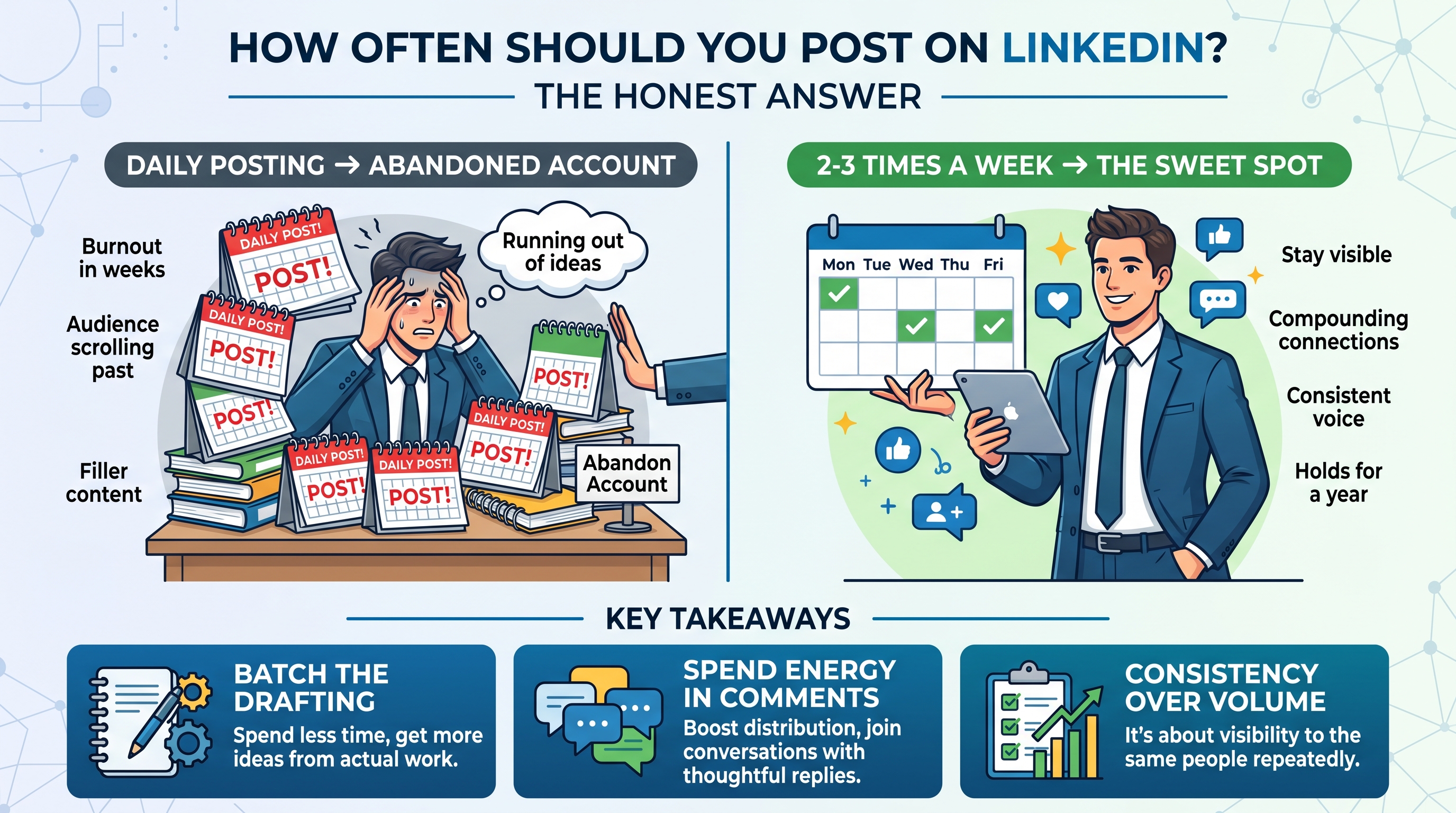
How often should you post on LinkedIn? An honest answer
Posting cadence advice usually comes from people selling cadence advice. Here's what actually compounds, and what burns you out.

How often should you post on LinkedIn? An honest answer
Posting cadence advice usually comes from people selling cadence advice. Social media agencies, LinkedIn "growth" coaches, and scheduling tools all have a reason to tell you that more is better — it sells more seats on their platform. So here's the version without the sales pitch: what actually compounds your reach, and what just burns you out.
The short answer
For most people, 2 to 5 posts a week is the range that keeps showing up. LinkedIn itself recommends 2–3 posts a week (its July 2026 creator checklist), and Buffer's analysis of ~2 million posts from more than 94,000 accounts found per-post engagement gains continuing all the way through 11+ posts per week — so there's no cliff where more posting suddenly stops working. The argument for restraint is sustainability, not the algorithm: posting more only helps if every post is worth reading.
If you're just starting out, 2 to 3 posts a week is a realistic, sustainable floor — in practice, less than weekly posting makes it hard to build momentum. If you're actively building an audience or job-hunting and want maximum visibility, 3 to 5 is the sweet spot most of the research converges on. Daily posting can work — but only if every post clears the bar, and for almost everyone, that bar gets harder to clear every single day.
Why "post every day" is bad advice for most people
The daily-posting advice usually comes from full-time creators whose job is making LinkedIn content. If content creation is your whole job, sure, daily is doable. If you're a working professional, a job seeker, or running a business on the side, daily posting quietly turns into a treadmill: you burn through your best ideas in the first two weeks, then start publishing filler just to keep the streak alive. Engagement drops, you notice, and you start wondering what changed. Nothing changed — you just ran out of good things to say and posted anyway.
There's also a practical reason to space your posts out: a strong LinkedIn post can keep generating views and comments for a day or two after publishing. Publishing again the next morning doesn't add reach so much as split your audience's attention across two posts — and it costs you the time and energy you could have spent making the first one better. The tradeoff for more frequency is always quality, not the algorithm.
What actually moves the needle more than frequency
Two things matter more than how often you hit publish.
The first 60–90 minutes after you post. LinkedIn shows a new post to a small slice of your network first, then watches how they react — comments, dwell time, shares. If that early signal is strong, distribution opens up to second- and third-degree connections. If it's weak, the post quietly dies. This is why a single well-timed, well-written post can outperform three rushed ones: the algorithm is grading the first hour, not the fact that you showed up.
Format. SocialInsider's analysis found native documents lead at 6.90% engagement, followed by multi-image posts at 6.80%, video at 5.90%, images at 5.00%, and text-only posts trailing at 4.35%. If you're posting twice a week instead of five times, spend the extra time turning one of those two posts into a carousel or a short video instead of another paragraph of text.
Commenting, not just posting. This is the part almost nobody talks about. A thoughtful comment on someone else's popular post puts your name and headline in front of their entire audience for free, with far less effort than writing your own post. A realistic weekly rhythm of 2 solid posts plus a handful of genuine comments on other people's content often outperforms daily posting with zero engagement elsewhere.
A cadence that's actually sustainable
If you want a starting framework instead of a vague "post more" instruction, try this weekly mix:
1 value post — a tip, a lesson, or a short how-to your audience can actually use
1 story or opinion post — something personal or a take that invites disagreement, since these tend to drive comments
1 carousel or document post — your highest-effort post of the week, saved for your best idea
A handful of thoughtful comments on other people's posts spread across the week, especially in your niche
That's roughly 3 posts a week, which sits comfortably inside the range the data supports, and it's a pace almost anyone can maintain for months instead of quitting after three weeks.
What to do
Stop chasing a number and start protecting quality. Pick 2–3 days a week that you can realistically show up with something worth reading, space your posts at least a day apart so each one gets a fair window, and put your extra effort into format (carousel or video) rather than an extra post. If you're job hunting specifically, consistency over 60+ days — even at a modest 2–3 posts a week — is what gets you recognized as "the person who talks about X," which matters far more to recruiters scrolling your profile than a raw post count ever will.
When to post: what the timing data actually says
Timing won't save a weak post, but it can give a good one a better first hour. The 2026 datasets converge more than they disagree. Buffer's analysis of 4.8 million LinkedIn posts found engagement peaking in the afternoon — roughly 3 to 8 PM — with Wednesday the strongest day. Sprout Social's dataset, nearly 2 billion engagements across 307,000 profiles, points to Tuesday through Thursday, 11 AM to 5 PM. The overlap both agree on: Tuesday–Thursday is the core window, weekends are close to dead, and the old "post at 9 AM sharp" rule has no special evidence behind it.
One honest caveat: the exact best hour differs by study, audience, and country — mornings win in some datasets, afternoons in others. So treat the Tuesday–Thursday window as your starting point, then check your own post analytics after a month and let your audience settle the tiebreaker. If your followers are mostly in a different time zone than you, post in their morning, not yours.
The 60-minute-per-week LinkedIn system
Here's a concrete weekly routine that fits inside an hour and covers everything the data says matters:
Monday, 15 minutes: Draft your two posts for the week in a notes app — one value post (a tip or lesson), one story or opinion post. Don't publish yet; let them sit a day so you can edit with fresh eyes.
Wednesday, 20 minutes: Publish post #1 inside the Tuesday–Thursday window, then spend ten minutes leaving thoughtful comments on three or four posts in your niche. Commenting is the highest-ROI activity most people skip entirely.
Thursday, 15 minutes: Publish post #2 — or your carousel/document post, saving your best idea for the format with the highest engagement ceiling. Another quick round of comments.
Friday, 10 minutes: Glance at analytics. Which post got saves? Which one drove profile visits? That single observation shapes next week's topics.
That's roughly three posts a week, spaced a day apart, with commenting baked in — the exact mix the research supports, at a pace you can hold for a year without burning out.
Frequently Asked Questions
Is posting once a week enough?
It's the minimum to stay visible, but you'll grow slowly. LinkedIn says Company Pages that post weekly see ~2× engagement — but 2–3 times a week outperforms once a week by a wide margin without much extra effort.
Can you post too much on LinkedIn?
Yes, functionally. Posting more than once in a 24-hour window rarely helps, because your second post competes with your first for the same audience instead of reaching a new one. Multiple posts a day is where the quality cost — and the risk of burning yourself out — starts outweighing any gains.
Does LinkedIn punish inconsistent posting?
There's no explicit "penalty," but inconsistency means you're constantly starting from a cold audience instead of building on momentum. A modest, steady cadence beats sporadic bursts of high activity followed by silence.
What's the best time of day to post on LinkedIn?
Aim for the Tuesday–Thursday core, roughly late morning to mid-afternoon in your audience's time zone. Buffer's 4.8M-post analysis found afternoon peaks; Sprout Social's 2B-engagement dataset points to 11 AM–5 PM. Don't over-optimize the hour — consistency and quality move the needle far more than whether you post at 10:30 or 1:15.
Should I use a scheduling tool to post?
If it helps you stay consistent, yes. Scheduling removes the "I'll post later" friction that kills most cadences. Just don't schedule and disappear — a scheduled post with zero follow-up engagement (no replies to comments) underperforms one where you're present in the first couple of hours. The tool handles timing; you still handle the conversation.
Do I need to post on weekends to stay visible?
No — weekend posting on LinkedIn consistently underperforms weekday posting in every major 2026 dataset, and it trains your audience to expect content when they're least likely to engage. Keep weekends for drafting ideas, not publishing them.
Was this article helpful?
Be the first to rate this article
Get weekly resume tips
Practical ATS and job search advice every week. No fluff, unsubscribe anytime.
Keep reading



Is your resume ATS-ready?
Run a free compatibility check — no account, no limits, nothing stored.
Check my resume